
Volleyball After 40: Playing the Long Game at the Net
The tendon ledgers, the first-week-back rule, and how shot selection outlasts arm speed
Updated October 20262 minute read
Volleyball after 40 is absolutely playable — rec leagues, grass doubles, and beach are full of players in their fifth and sixth decades — but the sport's jumping and overhead demands keep ledgers: patellar tendons and Achilles pay for volume spikes first, and shoulders want a real warm-up before full swings. The players who last aren't the ones who play less; they're the ones who built year-round calf, tendon, and cuff strength and learned that shot selection ages better than arm speed.
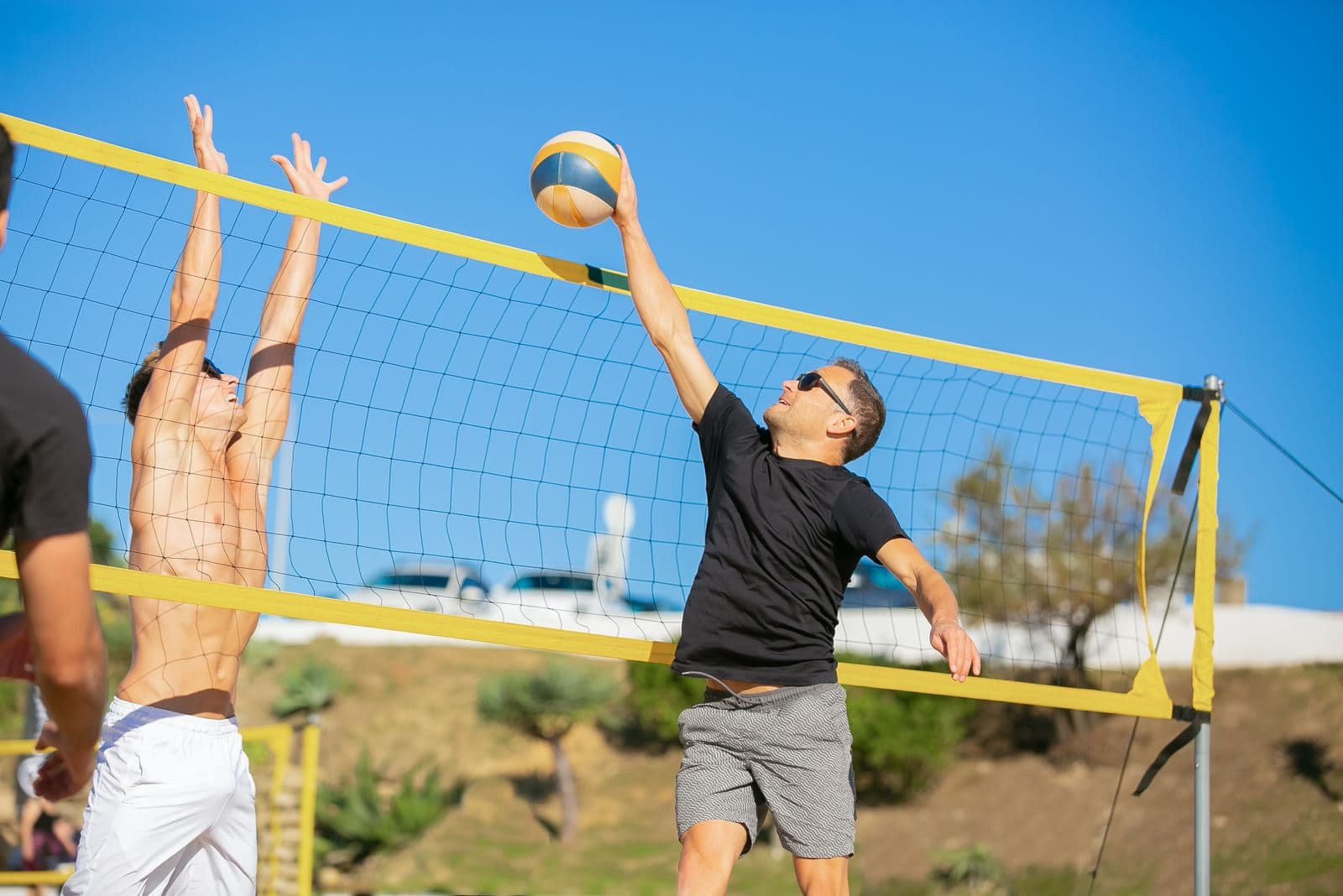
The sport ages better than its reputation
Walk into any rec league, grass tournament, or beach court and the 40-plus contingent is running the show — usually from the smart spots on the court. Team racquet-and-net sports keep showing up well in longevity research, and volleyball adds what aging bodies need most: jumping (bone and tendon stimulus), overhead reach, reaction, and a team that notices when you're gone.
The honest asterisk: volleyball's signature loads — maximal jumps and maximal-speed swings — are exactly the loads tendons tolerate less forgivingly with age. The sport doesn't need to be surrendered. The ledgers need to be paid.
The ledgers: what fades first (and what fixes it)
The patellar tendon and Achilles. Jumper's knee was named by this sport for a reason, and the over-40 version shows up after volume spikes: the first tournament of the season, the week you joined a second league. The fix is boring and proven — year-round tendon and calf strength, and jumping kept as a regular visitor instead of an occasional ambush.
The hitting shoulder. Swing speed is a tendon event too. Research on volleyball shoulders points at volume and technique as the drivers — neither of which cares about your birthday, both of which respond to management. The over-40 addendum: the warm-up before your first full swing is no longer optional.
Recovery time. The gap between "felt fine during" and "paid for it Tuesday" widens. Rest days between volleyball days are training, not time off.
The protection set
- Strength, year-round. Calf raises (straight and bent knee), single-leg work, heavy-slow tendon loading, cuff and scapular work — the full menu is two 25-minute sessions a week, and it roughly halves overuse risk across sports.
- The real warm-up. Progressive jumps and graduated swings before the first live ball — not two arm circles and a serve.
- Set-count budgets. A tournament Saturday is 6–10 sets; a league night is 3–5. Count them like the loads they are, and plan the next day accordingly (the load logic).
- The first-week-back rule. After any layoff — vacation, a busy month, an injury — the first week back is half volume, zero heroics. The comeback week is the sport's most reliable injury window.
Formats as strategy, not surrender
Reverse-coed, B-league sixes, and grass fours aren't retirement homes — they're craft leagues where positioning and shot selection beat arm speed, which is convenient, because shot selection is the skill that improves with age. And know the beach trade honestly: softer landings, higher total load.
The siblings tell the same story in other sports — basketball over 40 and pickleball after 50 — the dosage changes, the prescription doesn't.
When a PT check earns its fee
Before the season if you're returning after years away; promptly for a knee or shoulder that grumbles every session, a calf that "grabbed," or a niggle surviving two weeks of sensible modification. A cash-pay evaluation runs $125–$250 ($175–$275 in the Bay Area — what PT costs), usually ends with a modified week rather than a shutdown, and a superbill often recovers part of it. Here's how to find a PT who speaks volleyball, and Bay Area players can browse volleyball-friendly PTs by region.
Frequently asked questions
Sources (5)
- Lian OB, et al. Prevalence of jumper's knee among elite athletes from different sports: a cross-sectional study. Am J Sports Med. 2005. — AJSM
- Reeser JC, et al. Risk factors for volleyball-related shoulder pain and dysfunction. PM R. 2010. — PM&R
- Chodzko-Zajko WJ, et al. ACSM position stand: exercise and physical activity for older adults. Med Sci Sports Exerc. 2009. — MSSE
- Schnohr P, et al. Various leisure-time physical activities associated with widely divergent life expectancies. Mayo Clin Proc. 2018. — Mayo Clin Proc
- Gabbett TJ. The training-injury prevention paradox: should athletes be training smarter and harder? Br J Sports Med. 2016. — BJSM
This article is for education only and isn't medical advice. Always talk to a licensed clinician about your specific situation.