
Shoulder Pain When Hitting: What a Volleyball Shoulder Is Telling You
Spike volume, the patterns that route differently, and why hitters' shoulders are capacity problems
Updated October 20262 minute read
A spike is one of the fastest overhead motions in sport, repeated hundreds of times a week between hitting lines, serves, and matches — so most hitter's shoulder pain is a capacity problem: the rotator cuff and shoulder blade falling behind the volume asked of them. An ache at the front or outside that tracks hitting volume usually means cuff overload and responds to loading and load management. Night pain, true weakness, a shoulder stiffening in every direction, or numbness down the arm each route differently — and faster.
The math of a hitter's week
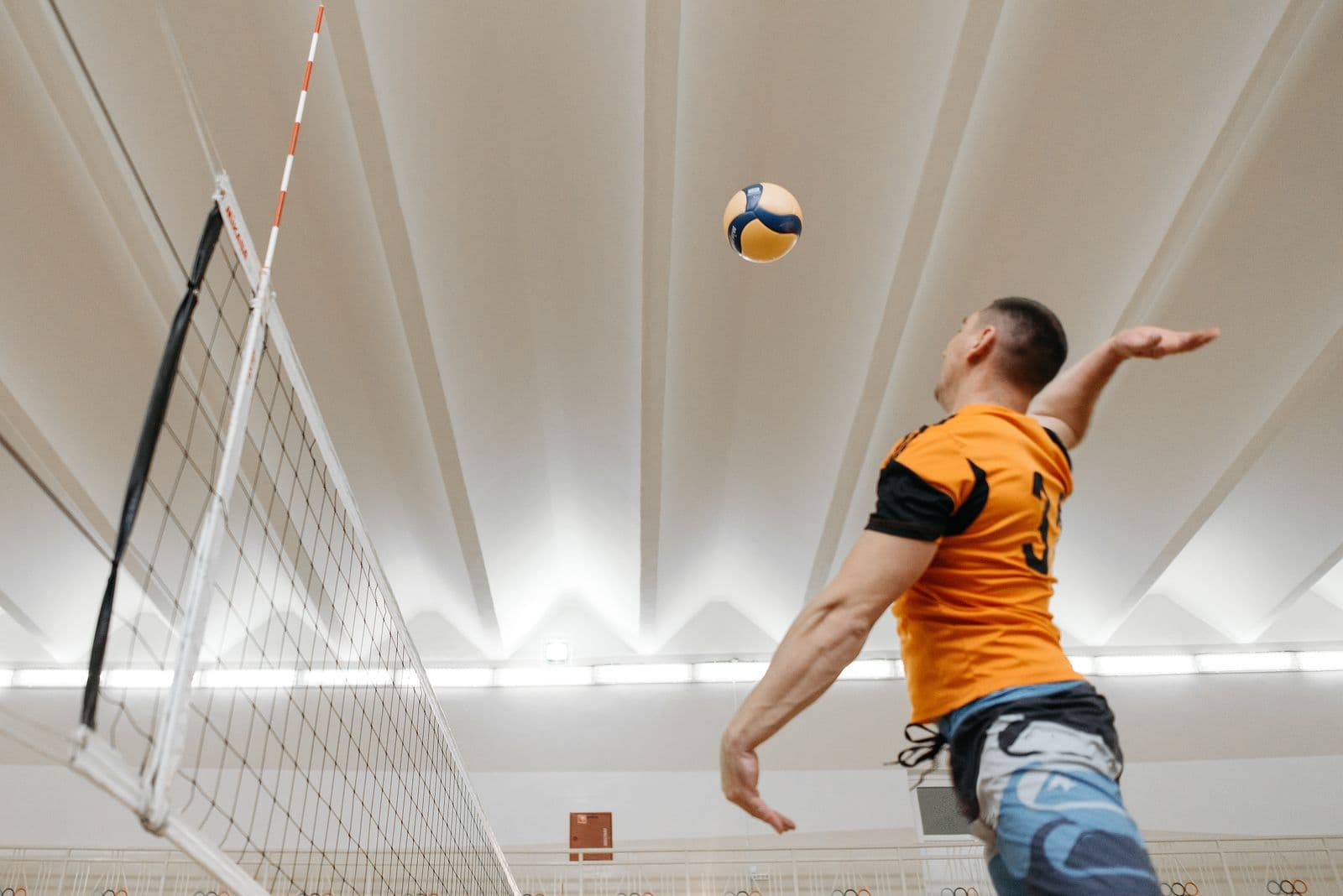
A hard spike takes the arm from cocked to contact faster than almost any motion in sport — and a hitter repeats it in hitting lines, serve receive drills, six rotations of matches, and every warm-up's down-balls. Add serves and the weekly overhead count runs into the hundreds. That's the frame for almost everything a volleyball shoulder does: this is rarely a "something tore" story and usually a volume-outran-capacity story, which is exactly why it responds so well to the unglamorous fixes.
Match your pattern
Ache at the front or outside that tracks hitting volume. Worst after heavy hitting days, grumbly overhead, settles with lighter weeks. That's the cuff-overload pattern — rotator cuff tendinopathy territory — and it's the hitter's default. Overhead-athlete research (including volleyball-specific work on scapular rhythm, posterior shoulder tightness, and the infraspinatus) keeps pointing at the same contributors: a shoulder blade that fatigues out of rhythm, a stiff posterior capsule, and cuff strength that never got trained as hard as the swing did.
Night pain, or true weakness turning the arm. A shoulder that wakes you, or an arm that fails rotation strength rather than just hurting, moves the conversation toward the rotator cuff tear lane — evaluation now, not after the next tournament.
A shoulder stiffening in every direction. Losing reach overhead, behind the back, and across the body — more stiff than sore — is its own condition (frozen shoulder) and needs different care entirely.
Numbness, tingling, or pain that moves with your neck. Symptoms running below the elbow, or reproduced by neck positions, point at a neck-referred problem — a different exam, covered in do I need PT for shoulder pain?
Why "capacity problem" is good news
You can't un-spike a season, but you can make a shoulder that absorbs it. The fix stack for the default pattern is consistent: scapular strength and endurance (the launchpad), rotator cuff loading (the engine's brakes), thoracic rotation (so the swing doesn't borrow from the shoulder), and posterior-shoulder mobility — all of it dosed alongside managed hitting volume rather than instead of playing. The full program lives in volleyball strength and landing, and swimmers' shoulders run on the same physiology — their guide is this page's overhead sibling.
The two-week trial
For the volume-tracking ache with no red flags: trim hitting-line reps and jump serves for two weeks, start basic cuff and scapular loading, and keep playing at the reduced dose. Improving means you've found the knob — keep turning it with the load guide. Not improving — or any red flag above — means book the evaluation.
When to get help
A cash-pay evaluation runs $125–$250 ($175–$275 in the Bay Area, what PT costs); a superbill often recovers part of it. A volleyball-literate PT will watch your arm swing, measure cuff and scapular strength, and build the plan around your club or beach schedule — here's how to find one, and Bay Area players can browse volleyball-friendly PTs by region.
Frequently asked questions
Sources (5)
- Challoumas D, et al. Insights into the epidemiology, aetiology and associations of infraspinatus atrophy in overhead athletes: a systematic review. Sports Biomech. 2017. — Sports Biomech
- Hosseinimehr SH, et al. Scapulohumeral rhythm, posterior capsule stiffness, shoulder muscle strength and flexibility in young volleyball players. BMC Musculoskelet Disord. 2025. — BMC Musculoskelet Disord
- Reeser JC, et al. Strategies for the prevention of volleyball related injuries. Br J Sports Med. 2006. — BJSM
- AAOS OrthoInfo. Shoulder impingement / rotator cuff tendinitis. — AAOS OrthoInfo
- MedlinePlus. Shoulder injuries and disorders. — MedlinePlus
This article is for education only and isn't medical advice. Always talk to a licensed clinician about your specific situation.