
Strength and Landing Training for Volleyball: What Actually Protects You
The volleyball four — calves and tendons, quiet landings, the hitting shoulder, and the hips behind the approach
Updated October 20262 minute read
Strength training is the best-supported injury-prevention tool in sports — meta-analysis evidence shows it roughly halves overuse injuries — and volleyball's version has four targets: calf and patellar-tendon capacity (the jump currency), single-leg strength with quiet-landing control (ankle and knee insurance), scapular and rotator-cuff loading (the hitting shoulder's insurance), and lateral hip with trunk rotation (the approach's engine). Two 20–30 minute sessions a week covers it.
The strongest evidence in injury prevention
Most volleyball advice is folklore; strength work is the exception. A large meta-analysis of prevention trials found structured strength training cut overuse injuries roughly in half — a bigger effect than any brace, shoe, or stretching routine has ever shown. In a sport whose whole economy runs on jump density, the athletes who lift are the ones whose tendons can afford the season.
The volleyball four
1. Calf and tendon capacity — the jump currency. Heavy calf raises (straight and bent knee) and heavy-slow patellar loading (slow squats, split squats, or decline work at a weight you can only move 6–10 times). This is both prevention and the proven treatment pathway for the knee the sport named — heavy-slow resistance beat injections in trial. If you only do one section of this page, do this one.
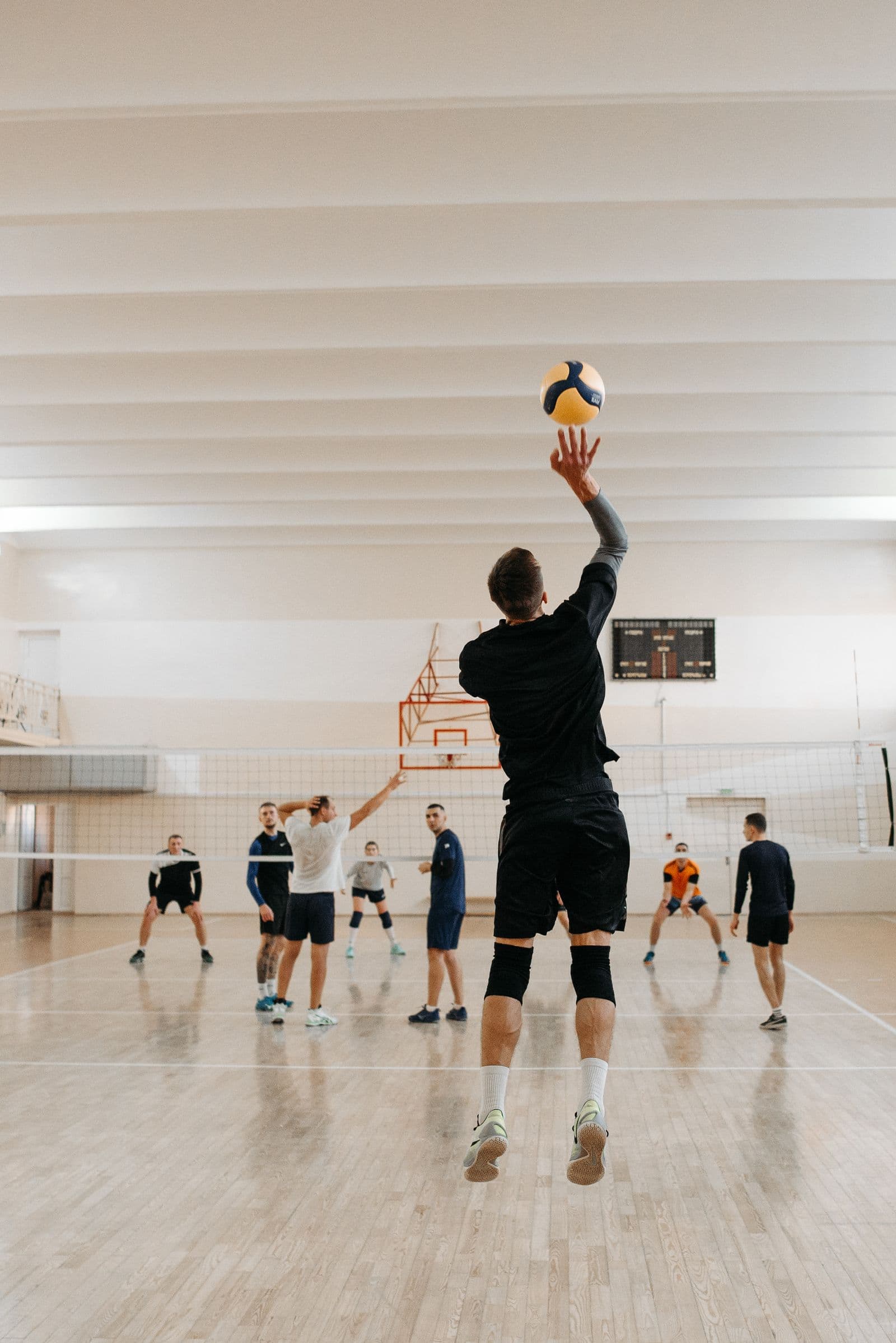
2. Single-leg strength and quiet landings. Step-downs and single-leg squats build the control; landing practice banks it — box step-offs landing soft and silent, stuck for two seconds, two legs before one. Build knee-over-toe tolerance rather than fearing it: the knee that can't load forward in training will be asked to anyway at the net. This is the ankle-and-ACL insurance aisle, and in volleyball the balance-board evidence is direct: a trial in volleyball players cut ankle re-sprains with simple daily balance work (the ankle page covers why re-sprains are the sport's quiet epidemic).
3. The hitting shoulder's insurance. Rows, Y-T-W raises, and external-rotation work at honest loads — the scapula is the launchpad and the cuff is the brake, and both fatigue long before the arm swing looks different. Dose it like training, not like a warm-up ritual: 2–3 sets approaching effort, twice a week, year-round. Pairs with the shoulder traffic-light rules when something's already talking.
4. Lateral hip and trunk rotation. Side planks, banded lateral walks, and medicine-ball rotation — the approach is a sprint into a rotation into a jump, and hips that can't decelerate send the bill to knees and backs (the back page covers the hitter's arch).
Plyo rules: earn the bounce
Jump programs work — on a prepared base. The order that keeps tendons out of trouble: strength first (months, not days), then landing quality, then low-dose bounce (skips, short hops), then real plyo volume — and never a new jump program mid-season on top of full practice load. The same jumping-sport logic as basketball's version, because the tendons can't tell the sports apart.
Dosing: in-season vs off-season
- Off-season: build — progress load week over week, three sessions if you love it.
- In-season: maintain — two 20–30 minute sessions, loads steady, nothing new, a buffer day before matches.
- Tournament weeks: keep one light session early in the week; skip the hero lift the day before ten sets.
When a PT should design it
If something already hurts, if you're returning from an injury, or if every season ends with the same knee or shoulder flare — one or two visits gets the program tailored to your tendon's actual state. A volleyball-literate PT (how to find one) tests before prescribing; cash-pay evaluations run $125–$250 ($175–$275 in the Bay Area, what PT costs), and Bay Area players can browse volleyball-friendly PTs by region.
Frequently asked questions
Sources (5)
- Lauersen JB, et al. The effectiveness of exercise interventions to prevent sports injuries: systematic review and meta-analysis. Br J Sports Med. 2014. — BJSM
- Verhagen E, et al. The effect of a proprioceptive balance board training program for the prevention of ankle sprains: a prospective controlled trial. Am J Sports Med. 2004. — AJSM
- Kongsgaard M, et al. Corticosteroid injections, eccentric decline squat training and heavy slow resistance training in patellar tendinopathy. Scand J Med Sci Sports. 2009. — SJMSS
- Malliaras P, et al. Patellar tendinopathy: clinical diagnosis, load management, and advice for challenging case presentations. J Orthop Sports Phys Ther. 2015. — JOSPT
- Doherty C, et al. The incidence and prevalence of ankle sprain injury: a systematic review and meta-analysis. Sports Med. 2014. — Sports Med
This article is for education only and isn't medical advice. Always talk to a licensed clinician about your specific situation.