
Strength Training for Soccer Players: The Best-Evidenced Menu in Sports
Nordics, Copenhagens, and landing control — the trial-tested exercises amateur teams skip for free
Updated October 20262 minute read
Soccer has the strongest injury-prevention evidence of any sport: Nordic hamstring curls roughly halved hamstring injuries in randomized trials, Copenhagen adduction work protects the groin, and single-leg strength with landing control is the backbone of ACL prevention programs. Professional clubs run this menu religiously; for amateurs it costs two 20–30 minute sessions a week and closes most of the gap.
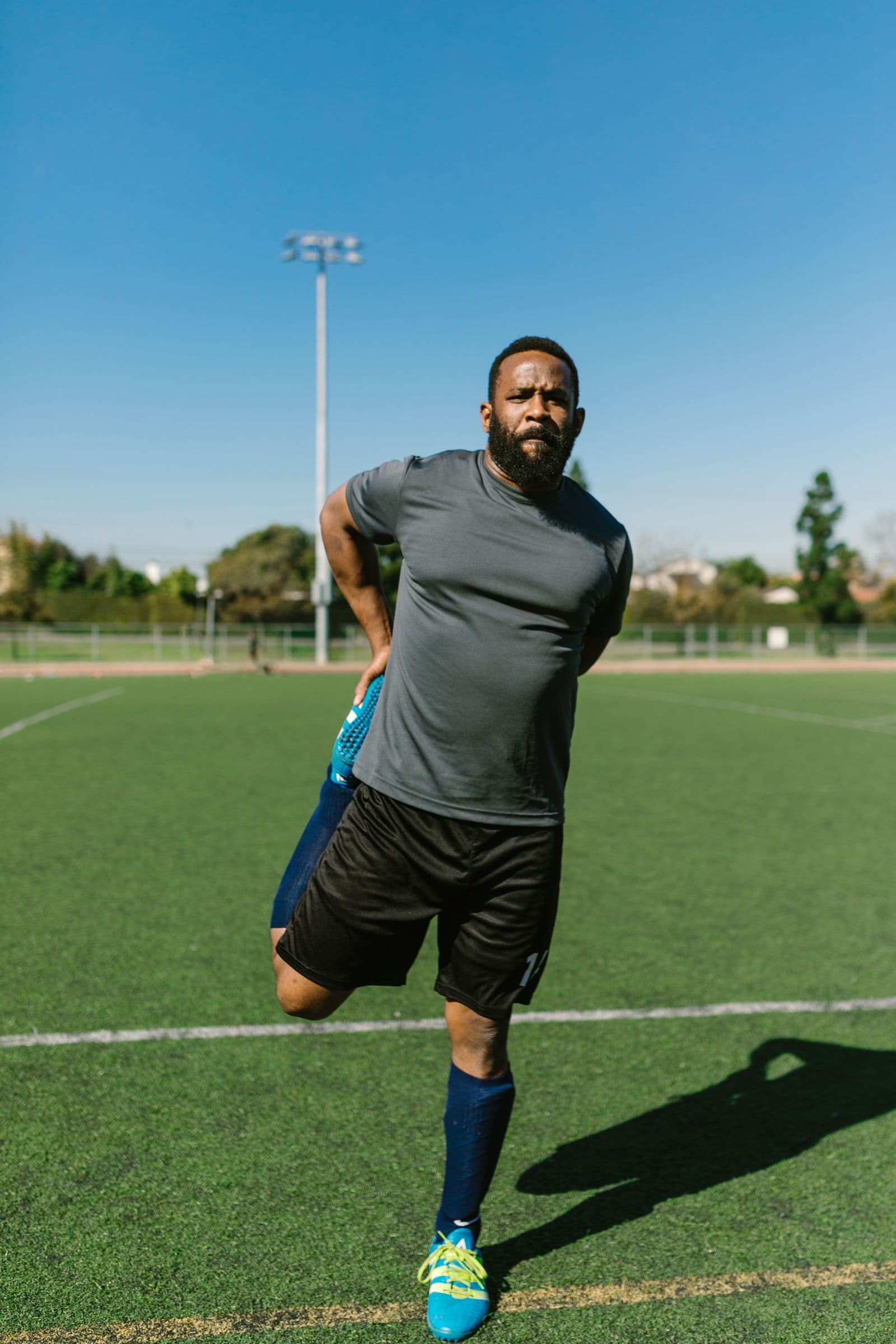
The strongest evidence in any sport
Most sports borrow their injury-prevention evidence from general research. Soccer generated its own, and it's unusually good: randomized trials in amateur players — not just pros — showing that specific, unglamorous exercises prevent the sport's specific injuries. Across sports, structured strength work roughly halves overuse injuries; in soccer, the trials get more precise than that, exercise by exercise.
The professional game took the hint years ago — every serious club's medical staff runs this menu. The amateur game mostly hasn't, which means the biggest injury-prevention gap in soccer is one that costs nothing to close.
The menu, ranked by evidence
- Nordic hamstring curls — kneel, ankles anchored (a partner, a couch, a barbell), lower your torso forward as slowly as you can. In a randomized trial of amateur players, a simple Nordic program roughly halved hamstring injuries. Given that hamstring strains are soccer's most common injury, this is the single highest-value exercise in the sport. Dose: start 2×3–4, build toward 3×6–8 over several weeks.
- Copenhagen adduction — a side plank with the top leg supported on a bench, lifting the body with the inner thigh. The groin's version of the Nordic, built for soccer's cutting and kicking — groin and adductor insurance in one move. Start with short levers and low reps; it bites like the Nordic does.
- Single-leg strength and landing control — split squats, single-leg Romanian deadlifts, and deliberate land-and-stick practice from small hops. This is the backbone of every ACL prevention program ever trialed: knees that track well under fatigue are trained, not inherited.
- Calf capacity — straight- and bent-knee calf raises, loaded. Ninety minutes of accelerations runs through the calf and Achilles, and the over-30 player's calf is usually the first tissue to complain.
The dose
Two sessions a week, 20–30 minutes, year-round. Heavier and slower in the off-season and preseason; lighter, consistent maintenance in-season (the trials dosed in-season — it works). Never introduce a new heavy exercise in the 48 hours before a match; novel soreness and sprint duels are a bad pair.
If you're starting mid-season: begin at half doses, expect soreness for two or three weeks, and don't quit during the adaptation window — quitting at week two is how this menu keeps not working for amateur teams.
Making it stick
The failure mode isn't effort; it's logistics. The fixes that work: bolt the menu onto the pre-match warm-up (which already contains warm-up doses of Nordics and landing work), make it a team habit rather than a personal one, and keep a sane weekly structure so the strength work lands on a body that isn't already overdrawn.
If something already hurts
Strength work is also the core of treatment for hamstring, groin, and tendon problems — but dosing around an irritated tissue is exactly where generic programs fail. The traffic-light rules sort what's trainable, and a cash-pay evaluation ($125–$250, $175–$275 in the Bay Area — what PT costs, often partly reimbursable via superbill) typically ends with a loading program you run alongside your season, not a stop order. How to find a soccer-literate PT covers the vetting; Bay Area players can start with the soccer PT directory.
Frequently asked questions
Sources (5)
- van der Horst N, et al. The preventive effect of the Nordic hamstring exercise on hamstring injuries in amateur soccer players: a randomized controlled trial. Am J Sports Med. 2015. — AJSM
- Lauersen JB, et al. The effectiveness of exercise interventions to prevent sports injuries: systematic review and meta-analysis. Br J Sports Med. 2014. — BJSM
- Petersen J, et al. Preventive effect of eccentric training on acute hamstring injuries in men's soccer: a cluster-randomized controlled trial. Am J Sports Med. 2011. — AJSM
- Hammes D, et al. Injury prevention in male veteran football players — a randomised controlled trial using 'FIFA 11+'. J Sports Sci. 2015. — J Sports Sci
- Silvers-Granelli H, et al. Efficacy of the FIFA 11+ Injury Prevention Program in the Collegiate Male Soccer Player. Am J Sports Med. 2015. — AJSM
This article is for education only and isn't medical advice. Always talk to a licensed clinician about your specific situation.