
Can I Play Soccer Through Pain? The Rules Players Actually Use
A traffic-light system for match days — and the hamstring warning sign most players ignore
Updated October 20263 minute read
Mild pain (0–3 out of 10) that doesn't change your stride and settles within 24 hours is generally safe to play through with modifications — fewer minutes, no sprint repeats. Pain above that, pain that builds through matches, or hamstring "tightness" that shows up at sprint speed means cut volume and start a two-week clock. A mid-sprint grab, a pop with swelling, or a knee that gives way means off the pitch and get assessed now.
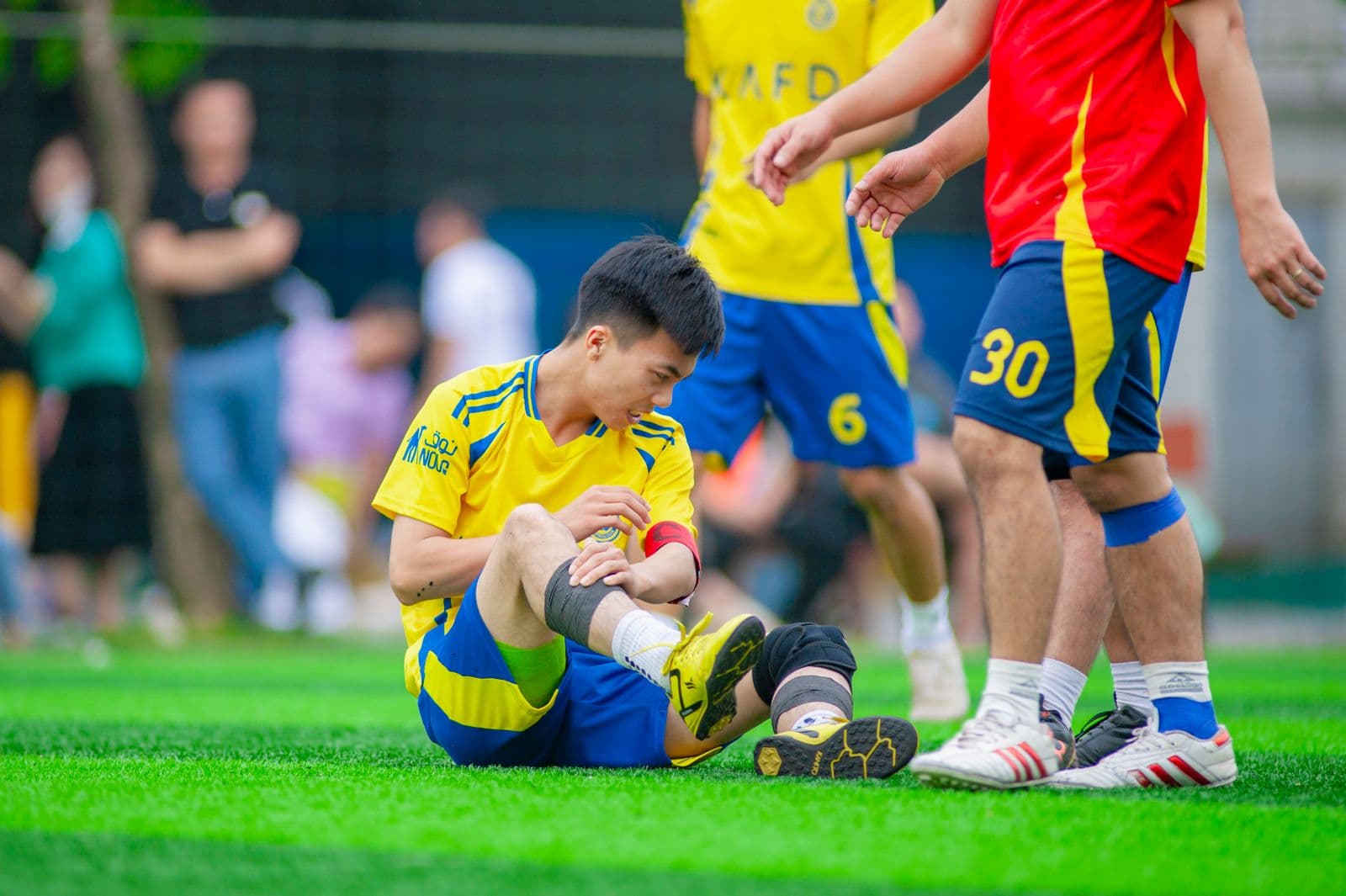
The traffic-light rules
Soccer players don't want "listen to your body" — they want to know whether to play Saturday. Here's the system, on a 0–10 pain scale:
Green — play, with eyes open. Pain sits at 0–3, doesn't change your stride, doesn't climb through the match, and is back to baseline within 24 hours. This level during training or rehab is generally acceptable — pain-monitoring research across sports shows athletes who kept training within these limits recovered as well as those who rested. Keep the modifications below in place anyway.
Yellow — modify now. Any of: pain above 3, pain building as the match goes on, pain that's changing how you run or strike the ball, a morning-after flare — or the soccer-specific one: hamstring tightness that shows up at sprint speed. That last one is the pre-strain warning shot, and it deserves a week of respect, not a shrug. Cut minutes, skip sprint duels, start a two-week clock. No progress when it rings: book the evaluation.
Red — off the pitch today. A mid-sprint grab in the hamstring or calf, a pop with swelling, a knee that gives way or locks, pain with every step, or anything that started with a collision and won't bear weight. These are the patterns from the hamstring and knee guides that need naming before anyone prescribes training — "see how next Saturday feels" is the wrong call here.
What "modify" actually means on a pitch
Not zero soccer — smarter soccer, in rough order of impact:
- Cut sprint exposure first. Decline the sprint duels, don't chase lost causes, no all-out counters. Sprinting is the hamstring's maximum load; it's the first thing out and the last thing back.
- Play fewer minutes — split halves, rotate off, volunteer for the sub role you normally dodge.
- Change your job for a week: a holding role, fullback with license to stay home, or a stint in goal keeps you in the game at a fraction of the sprint load.
- Keep the week between matches honest — easy running and the strength work that rebuilds whatever is complaining.
The weekend-league trap
Most amateur players train zero times between matches — which makes every match a load spike by definition. The counterintuitive fix: more running during the week, not less. A deconditioned body meeting ninety minutes of sprint demands once a week is the classic hamstring story; two short midweek sessions turn Saturday from a spike back into a normal day. The load-management guide maps it.
The detail that matters most: trend
One achy match is information. Three matches where the hamstring talked earlier each time — the 80th minute, then the 60th, then warm-ups — is a trajectory, and trajectories don't fix themselves mid-season. Track when in the match pain starts. Later each time usually means calming down; earlier each time means winding up.
When to bring in a PT
Two weeks of yellow that isn't clearing, any red pattern, or a hamstring or groin that complains every time you rebuild minutes. A cash-pay evaluation runs $125–$250 ($175–$275 in the Bay Area, what PT costs — often partly reimbursable via superbill), and mid-season it usually ends with "here's your modified month," not "stop." How to find a soccer-literate PT covers the vetting; Bay Area players can start with the soccer PT directory.
Frequently asked questions
Sources (5)
- Silbernagel KG, et al. Continued sports activity, using a pain-monitoring model, during rehabilitation in patients with Achilles tendinopathy. Am J Sports Med. 2007. — AJSM
- Askling CM, et al. Acute hamstring injuries in Swedish elite football: a prospective randomised controlled clinical trial comparing two rehabilitation protocols. Br J Sports Med. 2013. — BJSM
- Ekstrand J, et al. Epidemiology of muscle injuries in professional football (soccer). Am J Sports Med. 2011. — AJSM
- Gabbett TJ. The training-injury prevention paradox: should athletes be training smarter and harder? Br J Sports Med. 2016. — BJSM
- American Academy of Orthopaedic Surgeons, OrthoInfo. Hamstring Muscle Injuries. — AAOS OrthoInfo
This article is for education only and isn't medical advice. Always talk to a licensed clinician about your specific situation.