
Climbing After 40: Tendons, Warm-Ups, and the Long Game
Why older climbers keep sending — and what their fingers, elbows, and shoulders need in exchange
Updated October 20263 minute read
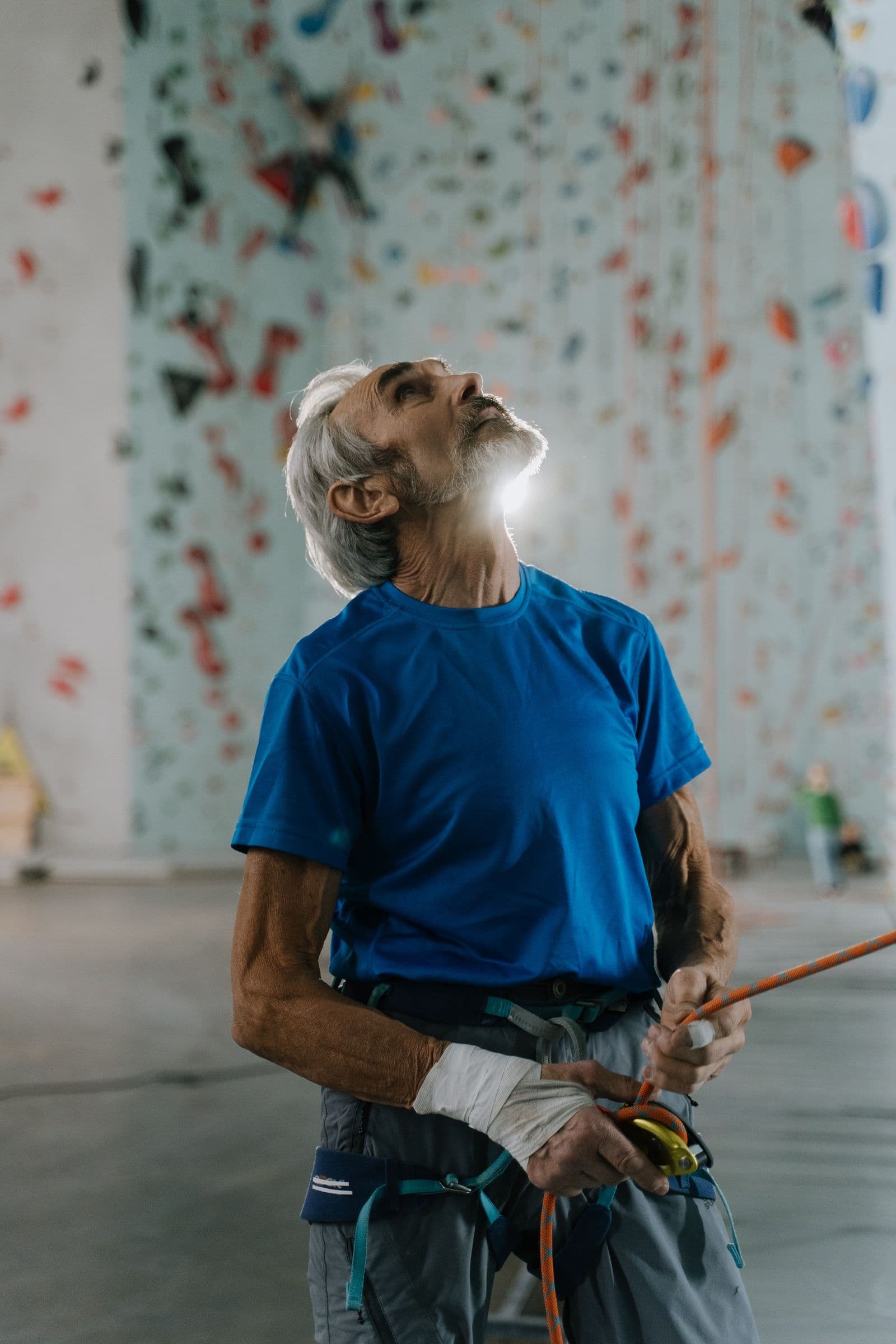
Climbing rewards experience enough that plenty of people climb their hardest in their 40s and 50s — finger strength responds well to training at any age. What changes is the maintenance contract: tendons and pulleys want longer warm-ups and more recovery, antagonist and cuff work stops being optional, session density needs a budget, and bouldering falls hit harder than they used to. Pay those bills and the sport keeps paying you back.
The good news first
Climbing ages better than almost any sport. It's low-impact by design, grades scale load with precision, and the thing that improves longest — technique, route-reading, body position — keeps compounding after raw power plateaus. Plenty of climbers put down their hardest sends in their 40s and 50s, and the research backs the mechanism: finger strength responds well to structured training in adults of any age. Indoor climbing's per-visit injury rate is genuinely low; the sport's problems are mostly overuse, which means they're mostly manageable.
What changes after 40 isn't the ceiling. It's the maintenance contract.
What your tendons renegotiate
Tendons and pulleys adapt more slowly with age and tolerate sudden spikes less gracefully. In practice:
- Warm-ups get longer and become non-negotiable. A warm-up pyramid — easy jugs, then moderate, then a few harder moves before anything near your limit — is the single cheapest protection in the sport. Cold full-crimping is how over-40 pulleys announce themselves.
- Recovery windows widen. The hard-session-every-day week that worked at 28 is now a load-management problem; most older climbers land on two, maybe three intense sessions a week with easy mileage between.
- Spikes hurt more than volume. A climbing trip after a desk month, a new board in the gym, a sudden crimp project — the workload research is blunt that it's the jump, not the total, that injures.
The maintenance work that stops being optional
- Antagonist and cuff work, year-round. Pushing exercises, wrist extensors, rotator cuff and scapular strength — the antagonist guide is the whole prescription, and the trial evidence on strength training for injury prevention is about as one-sided as sports science gets. This is what keeps climber's elbow and cranky shoulders theoretical.
- Hangboarding as maintenance, not just training. For experienced climbers, regular submaximal hangs keep finger tendons conditioned between projects — tendon upkeep, the way masters runners keep calf raises in the week. (New climbers and sore fingers are different conversations.)
- A session-density budget. Count your hard attempts, especially on boards and steep crimps. Quality over quantity isn't a slogan after 40; it's the difference between a season and a finger injury.
The honest risk: falling
Overuse is negotiable; gravity isn't. Bouldering falls hit harder after 40 — bone density, reaction time, and wrist/ankle resilience all move the wrong way, and the falls page covers what those landings cost. Strategy, not abstinence: downclimbing as a default habit, lower and less committing problems, rope climbing for the high-effort days, and honest self-talk about dynamic topouts. Many older climbers shift their hard climbing toward ropes precisely so they can keep trying hard without the impact lottery.
Technique is the superpower
The over-40 climber's edge is efficiency: better footwork, straighter arms, open-hand grips where younger climbers reflex-crimp (the grip guide), rests found mid-route. Every one of those skills reduces tissue load while raising grades — the rare free lunch in sports.
The pre-season PT check
One cash-pay visit before your big season or trip — shoulder range, cuff strength, finger-load tolerance, hip mobility for high steps — runs $125–$250 nationally, $175–$275 in the Bay Area (what PT costs; a superbill can recover part). Here's how to find a PT who actually climbs, and Bay Area climbers can browse climbing-friendly PTs by region. Fellow travelers: basketball over 40 and pickleball after 50 run the same playbook in other sports.
Frequently asked questions
Sources (5)
- Gilmore NK, et al. Effects of different loading programs on finger strength in rock climbers. Sports Med Open. 2024. — Sports Med Open
- Chodzko-Zajko WJ, et al. American College of Sports Medicine position stand: exercise and physical activity for older adults. Med Sci Sports Exerc. 2009. — ACSM
- Lauersen JB, et al. The effectiveness of exercise interventions to prevent sports injuries: systematic review and meta-analysis. Br J Sports Med. 2014. — BJSM
- Schöffl VR, et al. Acute injury risk and severity in indoor climbing — a prospective analysis of 515,337 indoor climbing wall visits. Wilderness Environ Med. 2013. — Wilderness Environ Med
- Gabbett TJ. The training-injury prevention paradox: should athletes be training smarter and harder? Br J Sports Med. 2016. — BJSM
This article is for education only and isn't medical advice. Always talk to a licensed clinician about your specific situation.