
Crimps, Grips, and Technique: How Climbers Spend Their Fingers
Every grip position is a load decision — here's what each one costs and when it's worth paying
Updated October 20263 minute read
Grip positions distribute load differently through the finger's tendons and pulleys: full crimp concentrates the most force on the pulleys, half crimp is the trainable standard, open hand is the pulley-friendliest, and pockets tax one or two fingers with the whole body's load. The honest rules: full crimp is a tool, not a default; train half-crimp and open-hand strength deliberately; treat pockets with respect; and remember that footwork and straight-arm technique are load management you can practice every session.
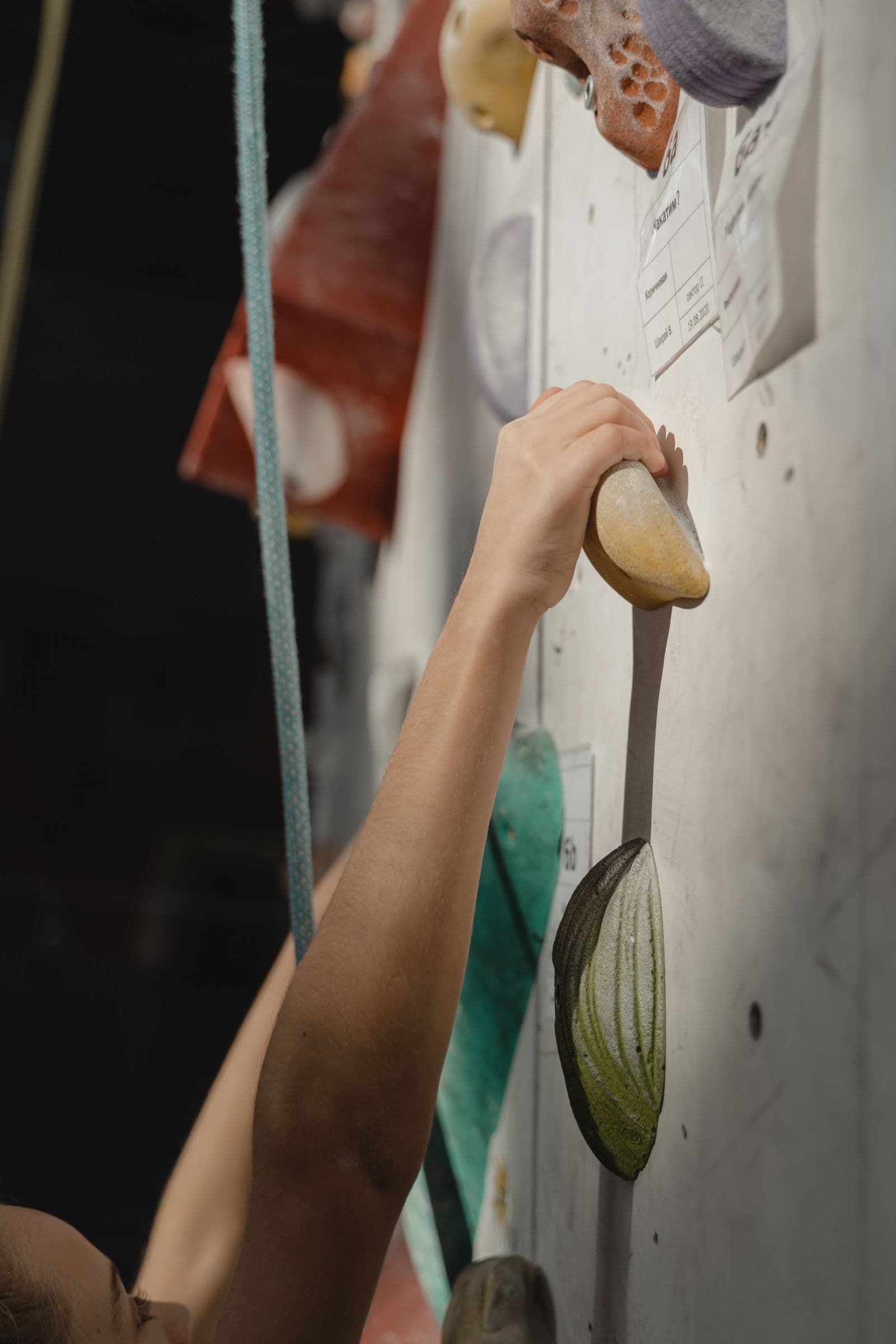
Every grip is a transaction
Holds don't injure fingers — grip positions do. The same edge held four different ways sends four different bills through the tendons and pulleys, and the climbers who last decades are the ones who know the prices. Here's the menu, from most expensive to least:
Full crimp — fingertips on the hold, joints hyperextended, thumb locked over the index finger. The strongest position on small incut edges and by far the most expensive: biomechanical testing of the crimp position shows it concentrates the highest forces on the A2 pulley — the structure behind climbing's signature injury. The thumb lock adds force the pulley has to answer for.
Half crimp — fingers bent about 90 degrees, no thumb. The training standard, and what coaches mean by "crimp strength." Strong on edges, substantially kinder than the full version, and the position virtually every structured finger program is built around.
Open hand / drag — fingers extended, hanging from the fingertip pads. The pulley-friendliest geometry, the grip for slopers and big edges, and the position rehab plans return climbers on. Weak at first for crimp-raised climbers; trainable into a superpower.
Pockets — one to three fingers in a hole. Not a grip angle so much as a load concentration: body weight through one or two digits. The research is specific about who pays — the middle and ring fingers carry the most pulley exposure in pocket positions, which is exactly which fingers pocket climbers hurt.
Pinches and slopers. Priced in different currency: pinches spend thumb strength, slopers spend skin, body position, and shoulder stability. Both are friendly to pulleys and hard on technique — which is the trade you want.
The honest rules
- Full crimp is a tool, not a default. Use it when the hold demands it; train it occasionally so it isn't a stranger; never default to it on holds the other grips could hold. Climbers who full-crimp everything are prepaying for the sport's most common injury.
- Train half crimp and open hand deliberately — they're the grips you'll live on, and strength in them is what makes the full crimp optional. The strength guide covers finger loading done right.
- Grip-switching is a skill. Matching the cheap grip to each hold mid-route is learnable — drill it on easy terrain, where open-handing everything turns a warm-up into finger training.
- Pockets deserve respect. Ease into pocket-heavy routes and boards gradually, prefer three-finger and two-finger open positions, and treat mono moves as the specialty equipment they are.
Technique is load management
The cheapest finger protection isn't a grip at all. Footwork quality is finger load reduction — precise feet, high steps, and weight kept over the toes offload the hands on every single move. Straight-arm climbing — hanging on the skeleton between moves instead of locked-off muscle — is the same gift to elbows and shoulders. Both matter most exactly where loads jump: the gym-to-outdoor transition, where jug-trained climbers meet crimp-sized reality, and any week the load ledger is running hot.
When grip pain belongs in a PT conversation
Pain that shows up on one grip type — crimps hurt, open hand doesn't; pockets light up one finger — is a localization clue, and it's the kind a climbing-literate PT turns into a diagnosis and a graded plan. Use the traffic-light rules for the session-by-session calls; two weeks without progress, or any pop, earns an evaluation ($125–$250 cash-pay, what PT costs — and a superbill can recover part of it). How to find a climbing PT covers the vetting, and Bay Area climbers can start with the local climbing PT directory.
Frequently asked questions
Sources (5)
- Schweizer A. Biomechanical properties of the crimp grip position in rock climbers. J Biomech. 2001. — J Biomech
- Vigouroux L, et al. Middle and ring fingers are more exposed to pulley rupture than index and little fingers during rock climbing. Clin Biomech. 2008. — Clin Biomech
- Jones G, et al. A critical review of the incidence and risk factors for finger injuries in rock climbing. Curr Sports Med Rep. 2016. — Curr Sports Med Rep
- Schöffl V, et al. Injury trends in rock climbers: evaluation of a case series of 911 injuries between 2009 and 2012. Wilderness Environ Med. 2015. — Wilderness Environ Med
- MedlinePlus. Finger injuries and disorders. — MedlinePlus
This article is for education only and isn't medical advice. Always talk to a licensed clinician about your specific situation.