
Shoulder Pain From Climbing: Cuff, Labrum & the Hang Debate
What gastons, wide moves, and a pulling-only sport do to shoulders — and the signs that change the plan
Updated October 20262 minute read
Climbing loads shoulders at end range under bodyweight, so the usual suspects are rotator cuff overload (an ache with overhead reaching that builds across a session), labral irritation (deep clicking or clunking on wide moves and gastons), and — in older climbers — night pain with true weakness that warrants evaluation for a cuff tear. Most climbing shoulders respond to scapular and cuff strengthening plus pushing work; night pain, giving-way weakness, or a shoulder that's losing motion are the signs to book an evaluation now.
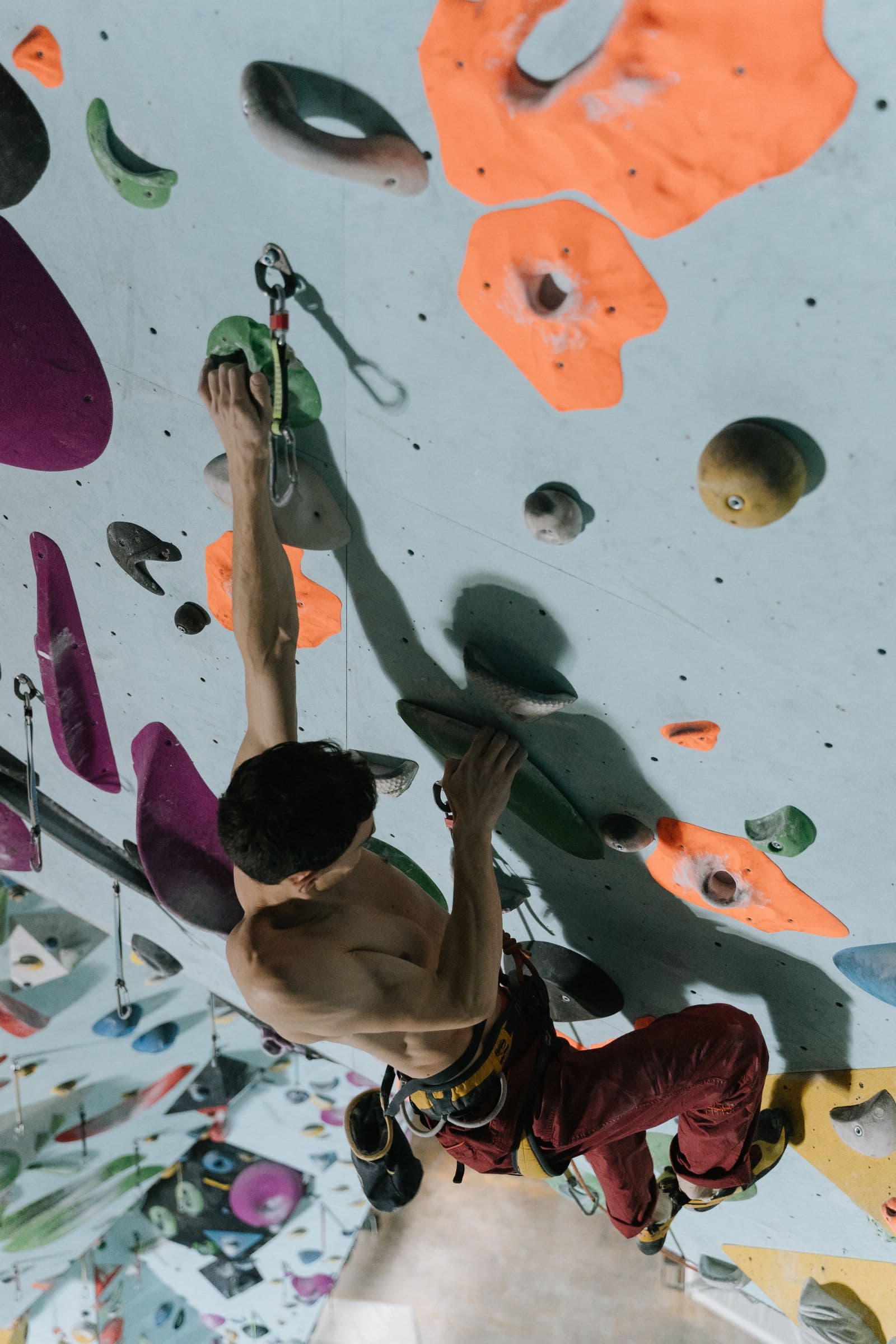
Why climbing shoulders complain
Climbing is the rare sport that routinely loads the shoulder at end range under full bodyweight — wide gastons, crossed underclings, shouldery compression moves, the dead-point catch at full stretch. Add the sport's structural bias — years of pulling development with almost nothing pushing back — and the shoulder works from a narrower margin than it looks. Injury surveillance consistently puts the shoulder among climbing's most injured joints, right behind the fingers.
The usual suspects, by story
- An ache that builds across a session, worse reaching overhead or sleeping on that side: rotator cuff overload — the small steering muscles running out of capacity for the volume. This is the most common climbing shoulder and the most fixable one (the condition in full).
- Deep clicking, clunking, or catching on wide moves and gastons, sometimes with a sense the joint might shift: the labral pattern — irritation of the cartilage rim that deepens the socket (what a labral tear means). Painless clicks are common and mostly benign; painful catching is the version that earns an evaluation.
- Night pain plus true weakness — the arm gives way, or lifting it is weak beyond what pain explains — especially over 40: evaluate for a rotator cuff tear rather than self-managing.
- A shoulder that's progressively losing motion, stiff in every direction: the frozen shoulder pattern, a different disease with a different timeline.
The active-hang debate, handled honestly
Climbing folklore says never hang passively — always keep the shoulders engaged. The kernel of truth: engaged hangs train useful scapular control. The overreach: treating passive positions as forbidden. Real climbing throws you into passive end range constantly (the cut-loose swing, the sagging rest), and overhead-athlete research points to capacity, not position-policing, as what keeps shoulders healthy. Build enough cuff and scapular strength that end range is a place you work from, not a cliff edge — then relaxed hangs stop being scary.
The fix: scapular, cuff, and pushing work
The evidence for rotator cuff problems is comfortably on exercise's side — progressive strengthening performs as well as more invasive care for most cuff disease, and strength training halves overuse injury risk across sports. For climbers the program has three legs: scapular control (the platform), direct cuff work (external rotations and overhead endurance), and pushing strength — the overhead press and push-up volume the sport never provides. The full template is in antagonist and strength training, and the volume side — because shoulder pain often arrives with a board-climbing or double-session spike — in climbing load management.
When to get evaluated
Book promptly for night pain, true weakness, numbness down the arm, progressive stiffness, or any shoulder that felt like it slipped — and book within a couple of weeks for the garden-variety ache that isn't trending better despite sensible edits. A climbing-literate PT (how to find one) sorts cuff from labrum from stiffness in one visit and builds the return — Bay Area climbers can browse climbing PTs by region. Evaluations run $125–$250 cash-pay ($175–$275 Bay Area), most cuff episodes resolve in 6–12 visits, and a superbill often recovers part of the cost (what PT costs).
Frequently asked questions
Sources (5)
- Challoumas D, et al. Determinants of debilitating shoulder pain and infraspinatus atrophy in overhead athletes. World J Orthop. 2017. — World J Orthop
- Page MJ, et al. Manual therapy and exercise for rotator cuff disease. Cochrane Database Syst Rev. 2016. — Cochrane
- Leung J. A Guide to Indoor Rock Climbing Injuries. Curr Sports Med Rep. 2023. — Curr Sports Med Rep
- Schöffl VR, et al. Prospective analysis of injury demographics, distribution, severity and risk factors in rock climbing. BMJ Open Sport Exerc Med. 2025. — BMJ Open SEM
- Lauersen JB, et al. The effectiveness of exercise interventions to prevent sports injuries: systematic review and meta-analysis. Br J Sports Med. 2014. — BJSM
This article is for education only and isn't medical advice. Always talk to a licensed clinician about your specific situation.