
The Basketball Warm-Up Pickup Culture Skips
Walk on, chuck threes, play — the ritual that feeds calf strains and rolled ankles, and the 6–8 minutes that prevent them
Updated October 20263 minute read
Shooting around is not a warm-up — standing jumpers don't prepare calves and ankles for the explosive first steps and landings of a live run, which is why so many calf grabs and rolled ankles happen in the first game of the night. The 6–8 minutes that matter: light jogging and slides, calf and ankle prep, hip openers, progressive jumps, short accelerations — then shoot. Structured warm-up programs cut injuries substantially in trials, including in elite basketball.
The most predictable injuries in the gym
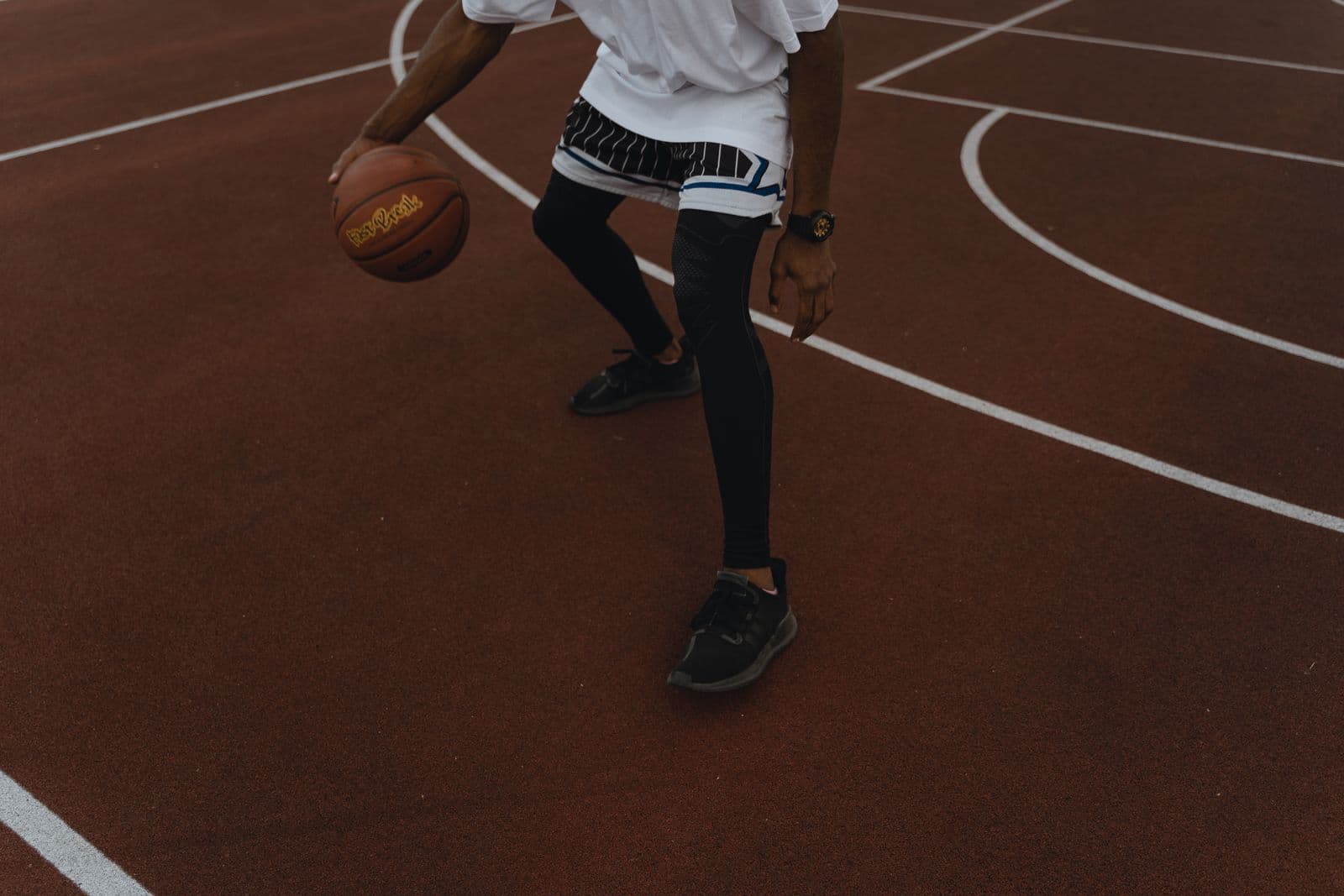
Watch any pickup night and you can call it in advance: somebody's calf grabs on a first-game fast break, or an ankle rolls under a cold landing, in the opening minutes — before anyone's broken a sweat. The pattern isn't bad luck. A live run's first explosive push-off asks the calf and Achilles for close to maximal output; a contested rebound asks a cold ankle to stabilize a single-leg landing in traffic. Tissue that spent the day in a desk chair and the last twenty minutes standing at the three-point line isn't ready for either.
The ritual — walk on, chuck threes, play — prepares exactly none of it. Shooting around is skill practice, not a warm-up: low, two-legged, self-paced jumps bear no resemblance to the first chase-down block of the night.
The 6–8 minutes that matter
Run it as one flowing sequence, baseline to baseline:
- Two minutes of easy movement — light jog, defensive slides both directions, backpedaling. Raise the temperature.
- Calf and ankle prep — the sport's money tissue. Twenty calf raises off a step or flat ground, ten ankle circles each way, then twenty quick low pogo hops (stiff ankles, small bounces). This is the section that protects against the calf grab and the rolled ankle.
- Leg swings and hip openers — front-to-back and side-to-side swings, a few walking lunges with rotation.
- Progressive jumps — five two-leg jumps at half effort, five at real effort with stuck landings, three single-leg hops each side. Landing practice is also knee insurance.
- Short accelerations and slides — three half-court builds to about 80% speed, two hard slide bursts each direction.
- Now shoot. Your stroke warms up fine in five minutes; your Achilles needed the first five more.
The evidence behind this structure is unusually good for sports medicine: cluster-randomized trials of neuromuscular warm-ups in team sports — including one of the FIFA 11+ adapted to elite male basketball — cut injuries by roughly a third, with the Scandinavian youth-sport trials showing the same for lower-limb injuries specifically.
The re-warm nobody does
Pickup's hidden cold-start: sitting out two games waiting for your run. Twenty minutes on the baseline undoes your warm-up — before you check back in, take ninety seconds: ten pogo hops, two slide bursts, one acceleration. The over-40 crowd should treat this as doctrine; everyone else should treat it as a cheat code for first-possession legs.
The 60-second desperation version
Late, and the run is waiting: twenty pogo hops, five real jumps with stuck landings, two hard accelerations, one slide burst each way. It's a fraction of the protection — and several times better than walking on cold. Then stay honest about the first game: no maximal chase-downs in minute one, per the load rules.
If something already hurts
A warm-up manages healthy tissue; it doesn't rehab injured tissue. A calf that grabs during warm-ups, a knee that needs ten minutes to stop aching, or an ankle you're wrapping "just in case" every week is telling you the preparation gap has already become a capacity gap — the traffic-light rules map the urgency, and a cash-pay evaluation runs $125–$250 ($175–$275 in the Bay Area — what PT costs, often partly reimbursable via superbill). Here's how to find a basketball-literate PT, and Bay Area players can browse basketball-friendly PTs by region.
Frequently asked questions
Sources (5)
- Longo UG, et al. The FIFA 11+ program is effective in preventing injuries in elite male basketball players: a cluster randomized controlled trial. Am J Sports Med. 2012. — AJSM
- Olsen OE, et al. Exercises to prevent lower limb injuries in youth sports: cluster randomised controlled trial. BMJ. 2005. — BMJ
- Soligard T, et al. Comprehensive warm-up programme to prevent injuries in young female footballers: cluster randomised controlled trial. BMJ. 2008. — BMJ
- Fradkin AJ, et al. Does warming up prevent injury in sport? The evidence from randomised controlled trials. J Sci Med Sport. 2006. — JSMS
- Lauersen JB, et al. The effectiveness of exercise interventions to prevent sports injuries: systematic review and meta-analysis. Br J Sports Med. 2014. — BJSM
This article is for education only and isn't medical advice. Always talk to a licensed clinician about your specific situation.