
Can I Play Basketball Through Jumper's Knee? The Traffic-Light Rules
Tendons like load and hate spikes — here's how to keep hooping without feeding the problem
Updated October 20262 minute read
Often yes — patellar tendons usually do better with managed load than with total rest. The rules: pain of 0–3 out of 10 that warms up during play and is back to baseline by the next morning is generally workable with trimmed jumping volume; pain above that, growing morning-after stiffness, or pain arriving earlier each session means cut volume and start a loading program; sharp sudden pain at the tendon, swelling, or pain on daily stairs means book an evaluation now.
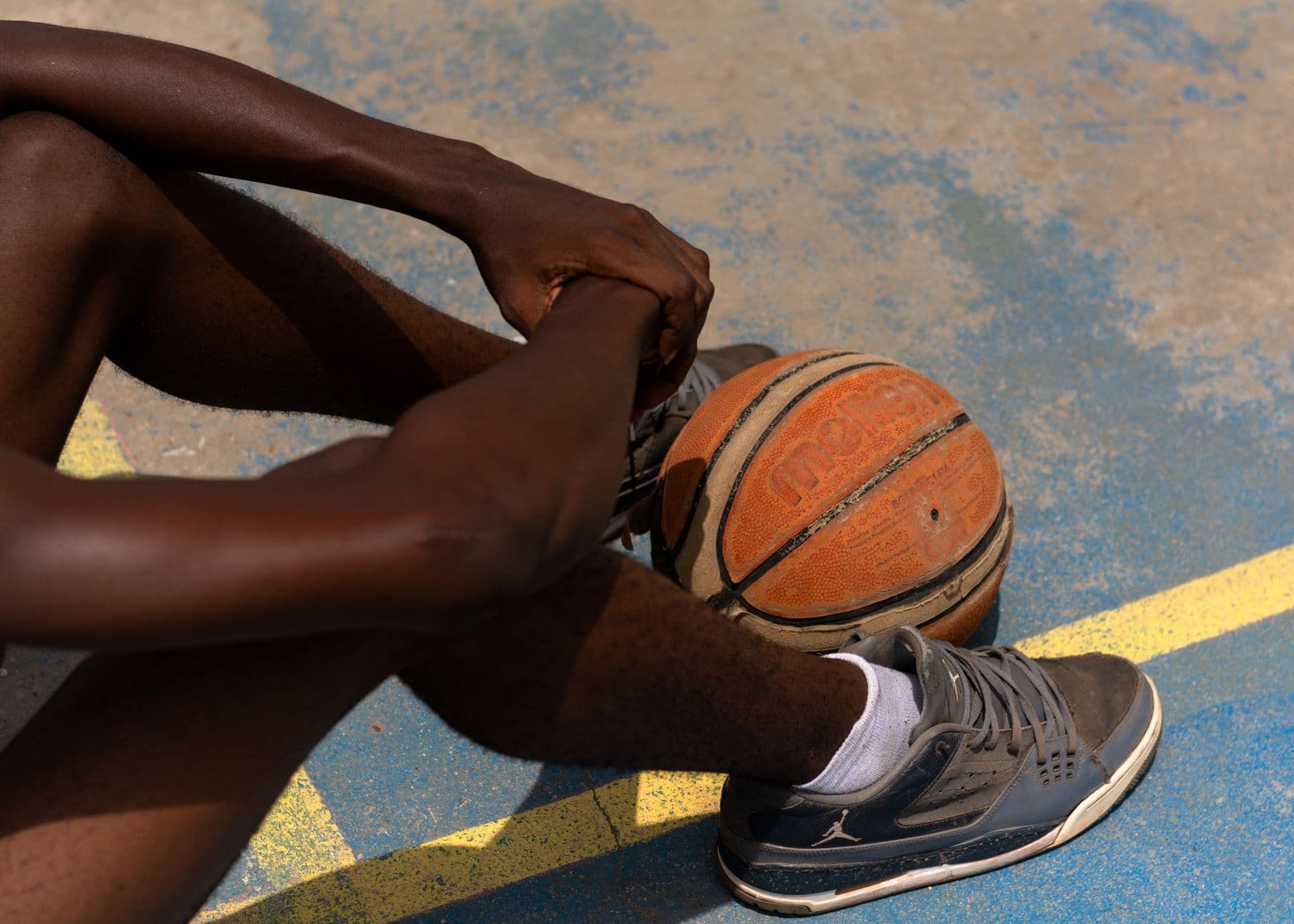
The traffic-light rules
Jumper's knee — patellar tendinopathy — is basketball's signature overuse problem, and it comes with a signature dilemma: it usually lets you play. Whether you should is a load question, and the pain-monitoring research gives you a usable system on a 0–10 scale:
Green — play, with a plan. Pain sits at 0–3, warms up as you play, doesn't change your jumping or landing, and is back to baseline by the next morning. That level is generally acceptable if it's stable week over week and you're running the modifications below — not just playing through and hoping.
Yellow — modify now. Any of: pain above 3, pain arriving earlier in each session, morning-after stiffness that's growing, or pain that has started showing up during warm-up itself. Trim jumping volume — fewer sessions, fewer max-effort jumps, no stacked league-plus-pickup weeks (the load math) — start a loading program, and put two weeks on the clock. No progress when it rings: book the evaluation.
Red — book now. Sudden sharp pain at the tendon during a jump (the rupture conversation nobody wants — especially with a history of long-standing tendon pain), visible swelling, or pain on daily stairs and sitting. These aren't "manage with fewer minutes" patterns.
The detail that matters most: the next morning
Tendons announce overload on a delay. The honest referee isn't how the knee feels in the fourth quarter — it's the stairs the next morning. Stable morning stiffness = the current load is near your ceiling. Growing morning stiffness = you're over it, whatever the games felt like.
Why rest alone famously fails
The trap every hooper falls into once: rest three weeks, feel great, return, and the pain is back by week two. Rest calms symptoms while capacity quietly drops — you return with a weaker tendon and the same schedule. Trial evidence points the other way: progressive loading (heavy, slow strength work) outperforms rest and injections for lasting change. That work lives in the strength guide, and it runs alongside modified play, not instead of it.
What "modify" actually means in basketball
- Cut the jumping, keep the game. Fewer full-court runs, more half-court; fewer max rebounds in traffic; skip the dunk sessions.
- Un-stack the week. One hard session, one easy, never back-to-back nights while symptomatic.
- Isometrics on off days — heavy holds that calm and maintain the tendon between runs.
- Respect the warm-up — a tendon that starts cold complains longest (the warm-up).
When to bring in a PT
Two weeks of yellow that isn't clearing, any red pattern, or a tendon that's been grumbling for months earn an evaluation — tendinopathy rehab is dose-sensitive, and the dose is individual. A cash-pay evaluation runs $125–$250 ($175–$275 in the Bay Area), usually ends with "here's your modified week and your loading program," and a superbill often recovers part of the cost. Here's how to find a PT who treats jumpers, and Bay Area players can browse basketball-friendly PTs by region.
Frequently asked questions
Sources (5)
- Silbernagel KG, et al. Continued sports activity, using a pain-monitoring model, during rehabilitation in patients with Achilles tendinopathy. Am J Sports Med. 2007. — AJSM
- Malliaras P, et al. Patellar Tendinopathy: Clinical Diagnosis, Load Management, and Advice for Challenging Case Presentations. J Orthop Sports Phys Ther. 2015. — JOSPT
- Kongsgaard M, et al. Corticosteroid injections, eccentric decline squat training and heavy slow resistance training in patellar tendinopathy. Scand J Med Sci Sports. 2009. — SJMSS
- Lauersen JB, et al. The effectiveness of exercise interventions to prevent sports injuries: systematic review and meta-analysis. Br J Sports Med. 2014. — BJSM
- MedlinePlus. Knee injuries and disorders. — MedlinePlus
This article is for education only and isn't medical advice. Always talk to a licensed clinician about your specific situation.