
Paddles, Buoys, Fins & Snorkels: What Swim Gear Does to Your Body
An honest look at the gear bag through a PT lens — what multiplies load, what reduces it, and what doesn't matter
Updated October 20263 minute read
Swim equipment is load management in disguise: paddles multiply shoulder load per stroke, pull buoys make the shoulders do all the propulsion, fins reduce shoulder work, and snorkels remove breathing asymmetry. None of it is good or bad — but every equipment change is a load change, and introducing gear suddenly is how training tools become the trigger for a shoulder flare.
The one rule that covers every item in the bag
Swim gear redistributes load. Paddles move more of it to the shoulders, fins move it to the legs, buoys concentrate it, snorkels rearrange the stroke around a stable head. Used deliberately, that redistribution is training and rehab gold. Introduced suddenly — new gear, big sets, same week — it's a load spike wearing a training-aid costume, the same math as any yardage jump. Introduce one piece of equipment at a time, in short sets, and let the body vote before the sets grow.
Paddles: the load multiplier
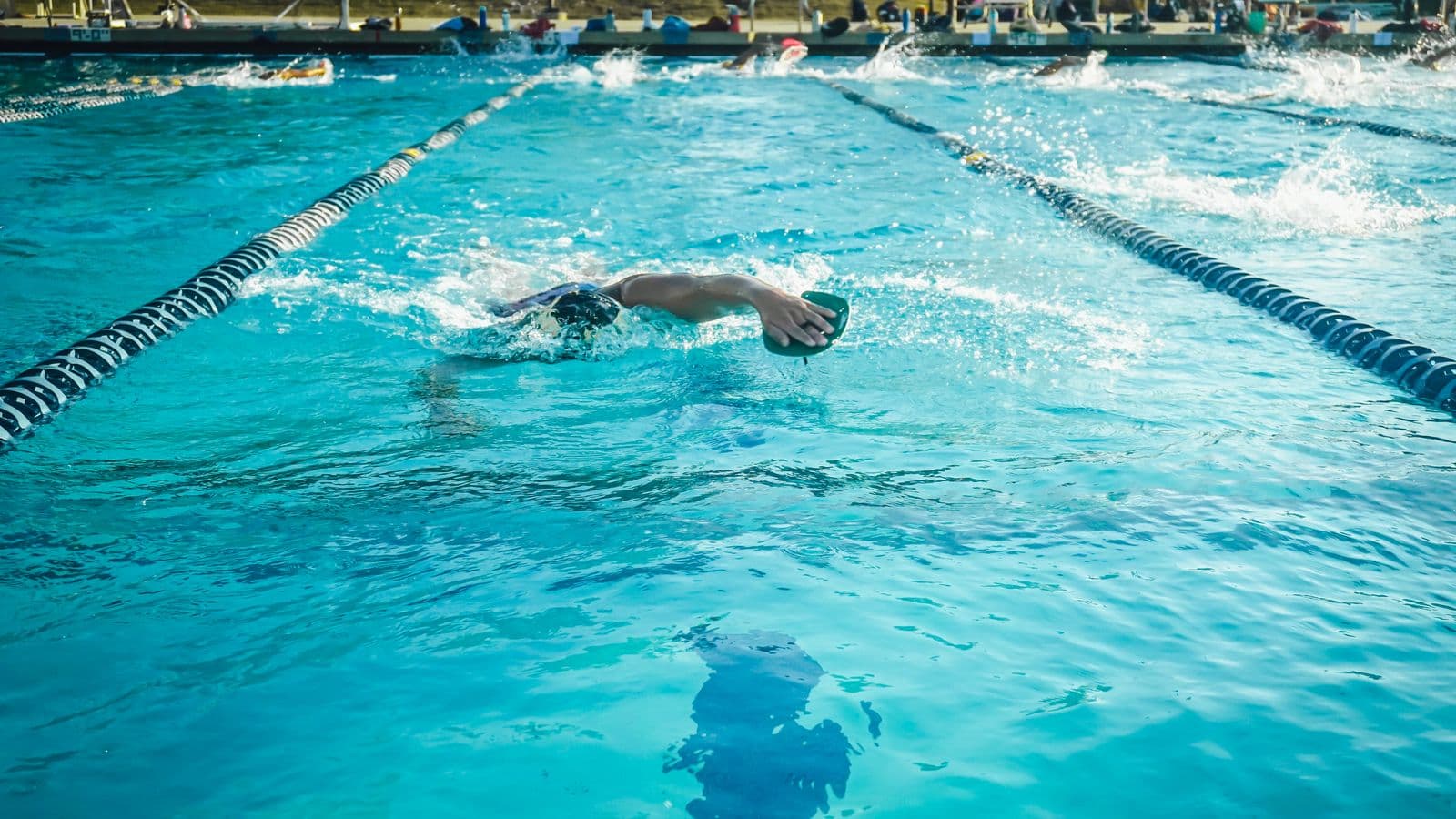
Paddles enlarge your hand, which raises the force of every pull — the whole point, and the whole risk. They're the single most common equipment trigger for swimmer's shoulder flares, almost always in one of two ways: paddles introduced in a big block after time away, or paddles sized up for ego. Keep them close to hand-sized, keep paddle sets a minority of the practice, and park them entirely while a shoulder is irritated — they're the first thing a PT pulls from the bag and the last thing added back.
Pull buoys: concentrated shoulder work
A buoy floats the legs, so the arms do all the propelling — long pull sets are the swimming equivalent of bench-pressing every lap. Fine in doses, and useful for isolating the catch; a problem when "easy pull" is the default set for a shoulder that's already grumbling. Two quieter costs worth knowing: buoy position holds the hips in stiff extension (some swimmers' backs ache after long buoy sets — the low back guide covers that pattern), and living on the buoy can paper over a sinking body position that technique work would actually fix.
Fins: the rehab tool hiding in plain sight
Fins shift propulsion to the legs and restore speed without shoulder strain — which is why they feature in nearly every return-to-swimming plan and most modified-practice weeks. Kick-and-drill blocks with fins keep an injured swimmer training while the shoulder rebuilds. The onboarding cost: new fins recruit calves and feet hard, so cramping is common for a couple of weeks. Short sets first, and pick a flexible fin over a stiff sprint blade for volume work.
Snorkels: the asymmetry eraser
A center-mount snorkel removes breathing from the stroke, which removes the sport's biggest built-in asymmetry — the head turn that makes one shoulder and one side of the neck work differently every cycle. That makes snorkels genuinely useful for neck complaints (including sighting neck from open water), for balanced technique work, and for rebuilding a stroke after injury with one less variable. The honest caveat: breathing against the tube is its own small workload, so ease in rather than snorkeling an entire practice on day one.
Tech suits: relax
Meet suits compress, cost a fortune, and shave tenths — and have essentially no injury story worth telling. Buy or skip them on speed and budget grounds; your shoulders don't care.
When your gear bag belongs in a PT conversation
Bring the equipment story to an evaluation when flares track with gear blocks — the shoulder that complains every paddle cycle, the back that aches after buoy-heavy weeks. That pattern is diagnostic gold: it names the load your tissue can't absorb yet, and a PT who works with swimmers (here's how to find one) will use the same gear to fix the problem — fins and snorkel early, paddles last, dosed like medicine. Evaluations run $125–$250 cash-pay (what PT costs), and Bay Area swimmers can browse swim-friendly PTs by region.
Frequently asked questions
Sources (6)
- Crocker GH, et al. Energetics of swimming with hand paddles of different surface areas. J Strength Cond Res. 2019. — JSCR
- Wanivenhaus F, et al. Epidemiology of injuries and prevention strategies in competitive swimmers. Sports Health. 2012. — Sports Health
- Sein ML, et al. Shoulder pain in elite swimmers: primarily due to swim-volume-induced supraspinatus tendinopathy. Br J Sports Med. 2010. — BJSM
- Yanai T, Hay JG. Shoulder impingement in front-crawl swimming: I. A method to identify impingement. Med Sci Sports Exerc. 2000. — MSSE
- National Library of Medicine. MedlinePlus: Sports Injuries. — MedlinePlus
- McKenzie A, et al. Shoulder pain and injury risk factors in competitive swimmers: A systematic review. Scand J Med Sci Sports. 2023. — Scand J Med Sci Sports
This article is for education only and isn't medical advice. Always talk to a licensed clinician about your specific situation.