
Low Back Pain in Swimmers: Why the 'Easy on the Back' Sport Isn't Always
Butterfly extension, flip turns, pull-buoy blocks, and the patterns worth sorting
Updated October 20262 minute read
Swimming is gentle on the spine compared with land sports, but it isn't zero-load: butterfly and breaststroke repeatedly extend the low back, flip turns add fast flexion-rotation, and long pull-buoy blocks stiffen the hips until the spine does their job. Most swimmer back pain is an extension-overload or deconditioning pattern that PT resolves with hip mobility, anti-extension core strength, and stroke adjustments — but leg numbness, weakness, or night pain moves you to the physician lane.
Wait — isn't swimming good for backs?
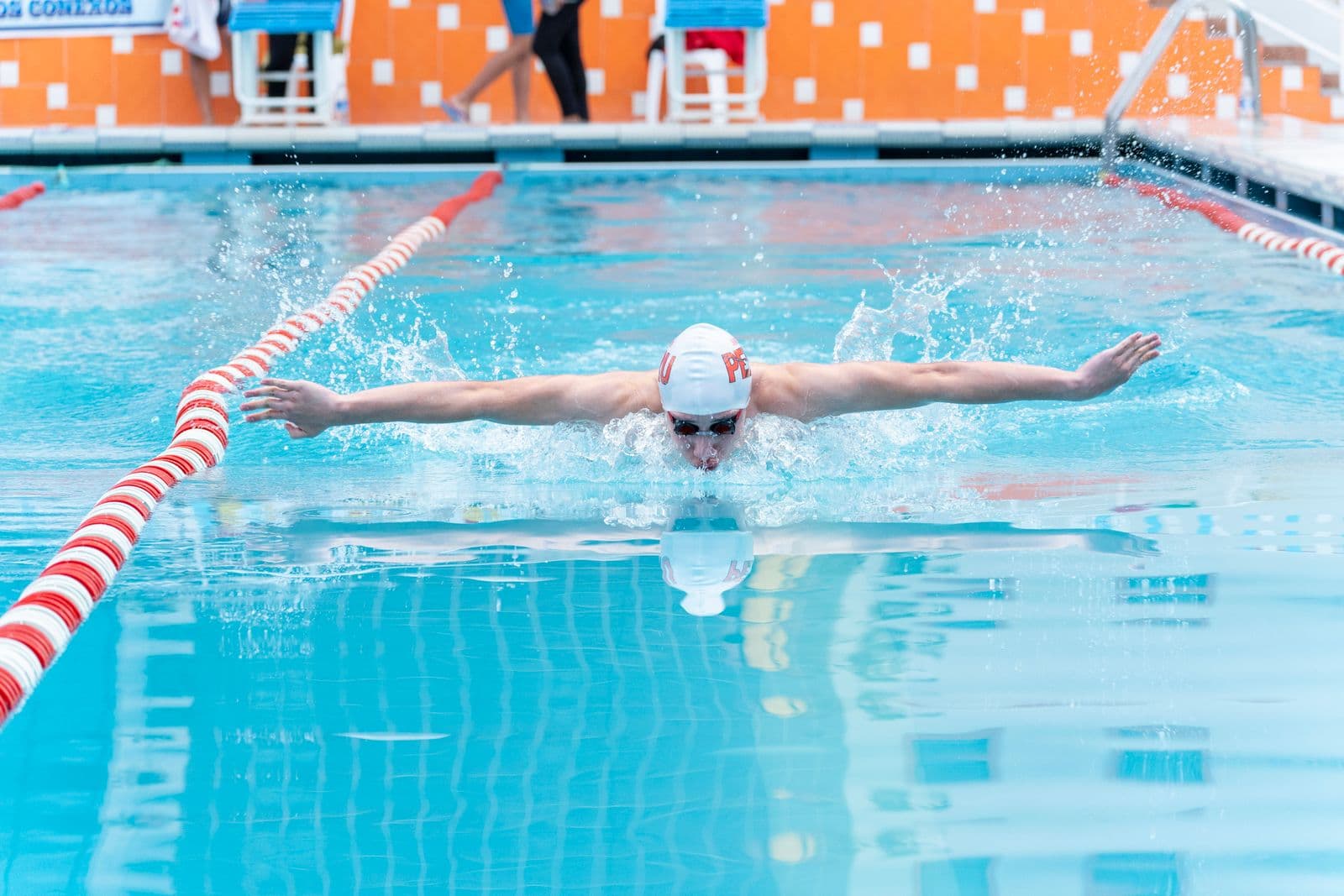
It is, mostly: no impact, horizontal posture, buoyancy carrying your weight. That reputation is exactly why swimmer back pain gets dismissed — including by swimmers. But the sport has its own spine loads: butterfly and breaststroke drive the low back into extension every stroke cycle, flip turns add a fast curl-and-twist hundreds of times a practice, and long pull-buoy blocks park the hips so the lumbar spine quietly holds an arch for whole sets. None of that is dangerous at tolerable doses. All of it can outrun a back's capacity when volume spikes.
The two patterns PTs see most
The extension-overload ache. Butterfliers and IM swimmers, back pain centered low and worse with fly sets, undulation drills, and long buoy blocks; eases with easy freestyle. This is the back's version of every overuse story on this site — tissue irritated by a repeated position, in this case arching. It responds well to the plan below, and its cousin on land is facet-style irritation.
The comeback ache. Masters swimmers returning after years away whose backs grumble everywhere — not one movement, just volume. This is usually deconditioning (trunk and hips not yet ready for the week), overlapping with ordinary lumbar strain territory, and it fades as general capacity returns if the ramp is sane — the masters guide covers the comeback math.
The red flags that change lanes
Pain with numbness, tingling, or weakness down a leg, back pain that's worse at night and doesn't change with position, or pain following real trauma — that cluster leaves load-management territory and goes to a physician first. The pattern most associated with leg symptoms is covered in back pain that radiates down the leg; do I need PT for back pain? walks the full triage.
How PT treats the swimmer patterns
- Hip mobility first. Stiff hip flexors and limited hip extension make the lumbar spine donate motion on every fly kick and buoy length — freeing the hips is usually the biggest single win.
- Anti-extension core strength. Planks, dead bugs, pallof presses — a trunk that can resist the arch, not just produce one.
- Stroke and volume adjustments. Smaller fly blocks, buoy sets broken up, undulation drills dosed, flip-turn technique checked. Managed load, not a swimming ban.
Most extension-pattern cases improve meaningfully in 4–6 weeks. The traffic-light logic swimmers use for shoulders applies to backs too: mild, settling within a day, not changing your stroke — train on with modifications; escalating or morning-after pain — cut back and get it looked at.
When to book
Two to three weeks of a back that isn't improving despite sensible modifications, pain that's changing your stroke or turns, or any red flag above. No referral needed in California (how to find a swimming PT); evaluations run $125–$250 cash-pay ($175–$275 in the Bay Area), often partially recoverable via superbill. Bay Area swimmers can browse swim-friendly PTs by region.
Frequently asked questions
Sources (7)
- Wanivenhaus F, et al. Epidemiology of injuries and prevention strategies in competitive swimmers. Sports Health. 2012. — Sports Health
- Folkvardsen S, et al. Does elite swimming accelerate lumbar intervertebral disc degeneration and increase low back pain? Eur Spine J. 2016. — Eur Spine J
- Kerr ZY, et al. Epidemiology of National Collegiate Athletic Association men's and women's swimming and diving injuries. Br J Sports Med. 2015. — BJSM
- Soligard T, et al. How much is too much? (Part 1) International Olympic Committee consensus statement on load in sport and risk of injury. Br J Sports Med. 2016. — BJSM
- National Library of Medicine. MedlinePlus: Sports Injuries. — MedlinePlus
- Thornton JS, et al. Treating low back pain in athletes: a systematic review with meta-analysis. Br J Sports Med. 2021. — Br J Sports Med
- Hayden JA, et al. Exercise therapy for chronic low back pain. Cochrane Database Syst Rev. 2021. — Cochrane Database Syst Rev
This article is for education only and isn't medical advice. Always talk to a licensed clinician about your specific situation.