
The Open-Water Swimmer's Guide to Staying Healthy
Sighting necks, wetsuit shoulders, cold water, and what changes when the pool walls disappear
Updated October 20263 minute read
Open water changes the load story: no walls or turns means unbroken stroke volume, sighting adds hundreds of neck extensions per swim, and wetsuits restrict shoulder mechanics while changing body position. Most open-water complaints — sighting neck, shoulder flares on long swims — are load problems a PT can fix without taking you out of the water, and the fixes usually start with technique and progression, not rest.
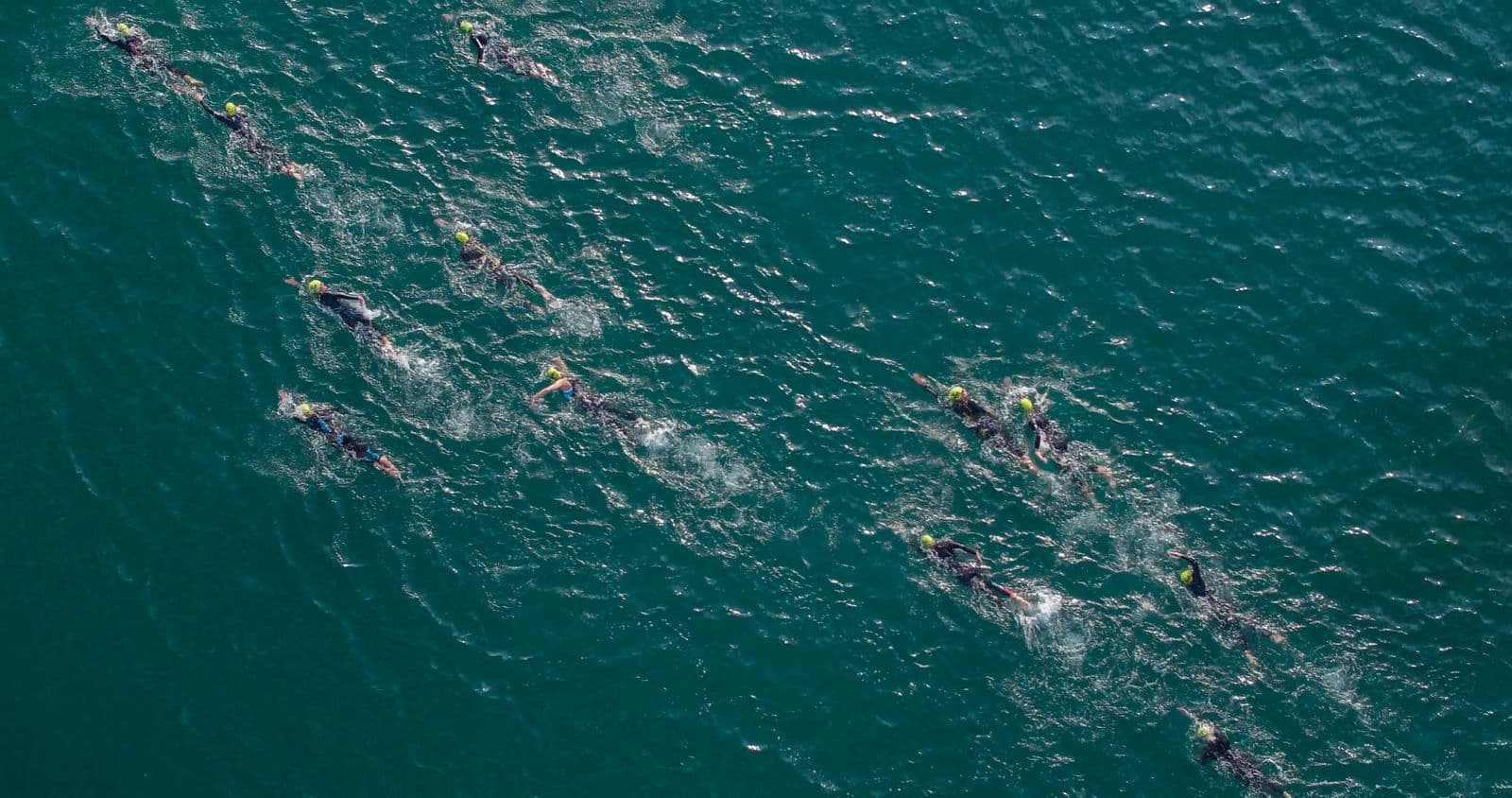
What actually changes when the walls disappear
Pool swimming has built-in interruptions: every wall is a push-off, a glide, and a second of shoulder rest, and every interval has a clock break. Open water deletes all of it. An hour in the bay is unbroken stroke volume — functionally more shoulder work than the same hour of pool sets — plus three demands the pool never makes:
- Sighting. Lifting the eyes to navigate extends the neck over and over — hundreds of repetitions on a long swim.
- Cold. Cold water stiffens muscles and shortens strokes early in a swim, exactly when you're also working hardest to settle your breathing.
- The wetsuit. Buoyancy changes your body position (hips high, kick quieter) while the rubber resists every arm recovery. Great for speed and warmth; not free for the shoulders.
None of this is a reason to stay in the pool. It's a load profile — and load profiles can be trained for.
Sighting neck: the signature complaint
The classic pattern: fine in the pool all week, stiff and sore neck after every open-water session. The fix is rarely rest; it's technique plus capacity. Sight lower and quicker — eyes barely over the surface, timed with the stroke so the hips don't drop — and sight in rhythm rather than craning for a long look. Breathe to both sides so one neck rotation doesn't do all the work. Then give the neck and upper back some strength to absorb what remains; the pulling patterns in the dryland guide cover the territory. Neck pain that lingers days after swims, or that sends tingling down an arm, has earned a proper evaluation.
Wetsuit shoulder
Long wetsuit swims concentrate load on the shoulders from two directions: the suit resists the recovery phase of every stroke, and its buoyancy changes your body position enough to alter the catch. The result is the familiar swimmer's shoulder pattern arriving on a shorter fuse. Practical defenses: a suit that genuinely fits (shoulder freedom beats a half-size of warmth), wetsuit time in training before race day rather than debuting it at the start line, and treating a big open-water block as the yardage jump it is. If a shoulder is already grumbling, the traffic-light rules apply in open water exactly as they do in the pool.
Cold water, briefly and sensibly
The Bay Area swims in 50-something-degree water year-round, and the institutions that make that normal — the Dolphin Club and South End Rowing Club at Aquatic Park, open-water groups across the region — are also the right teachers. Acclimatize gradually across weeks, never swim alone, know your exit before you get in, and treat shivering-impaired technique as the end of the session, not something to push through. Swimmers with cardiac history should clear cold immersion with their physician. The communities that run Alcatraz crossings have onboarded thousands of first-timers; borrow their experience instead of buying it yourself.
Training crossover with the pool
Count open-water volume honestly in your weekly load. A Saturday hour in the bay replaces more than an hour of pool intervals once you remove walls and add the suit — treat it like the long run in a running week, and let yardage progression logic govern how fast the open-water block grows. Triathletes stacking a swim block on bike and run volume have their own math.
When a PT earns a place in your open-water season
A sighting neck that technique changes don't quiet, a shoulder that flares on every long swim, or a comeback after injury that needs a criteria-based return plan — those are one-or-two-visit problems for a PT who understands swimmers ($125–$250 cash-pay, $175–$275 in the Bay Area, no referral needed — what PT costs has the numbers, and a superbill often recovers part of it). Here's how to vet one; Bay Area swimmers can browse swim-friendly PTs by region, and the local swimmer's guide covers the whole scene.
Frequently asked questions
Sources (6)
- Tipton MJ, et al. Cold water immersion: kill or cure? Exp Physiol. 2017. — Exp Physiol
- Wanivenhaus F, et al. Epidemiology of injuries and prevention strategies in competitive swimmers. Sports Health. 2012. — Sports Health
- Kerr ZY, et al. Epidemiology of National Collegiate Athletic Association men's and women's swimming and diving injuries. Br J Sports Med. 2015. — BJSM
- Soligard T, et al. How much is too much? (Part 1) International Olympic Committee consensus statement on load in sport and risk of injury. Br J Sports Med. 2016. — BJSM
- National Library of Medicine. MedlinePlus: Sports Injuries. — MedlinePlus
- McKenzie A, et al. Shoulder pain and injury risk factors in competitive swimmers: A systematic review. Scand J Med Sci Sports. 2023. — Scand J Med Sci Sports
This article is for education only and isn't medical advice. Always talk to a licensed clinician about your specific situation.