
Club Swimming Injuries: A Parent's Guide
Growing shoulders, year-round yardage, and how to keep a small complaint from costing a championship season
Updated October 20263 minute read
Club swimmers are the classic early-specialization athletes — many log ten or more practice hours a week by age twelve, year-round, in one sport. Most teen swimmer pain is overuse in a growing body and very fixable when someone looks at it early. The parent's job is simpler than it sounds: know the difference between sore and hurt, act on shoulder or knee pain that keeps showing up, and loop in the coach rather than around them.
Why club swimming is its own category
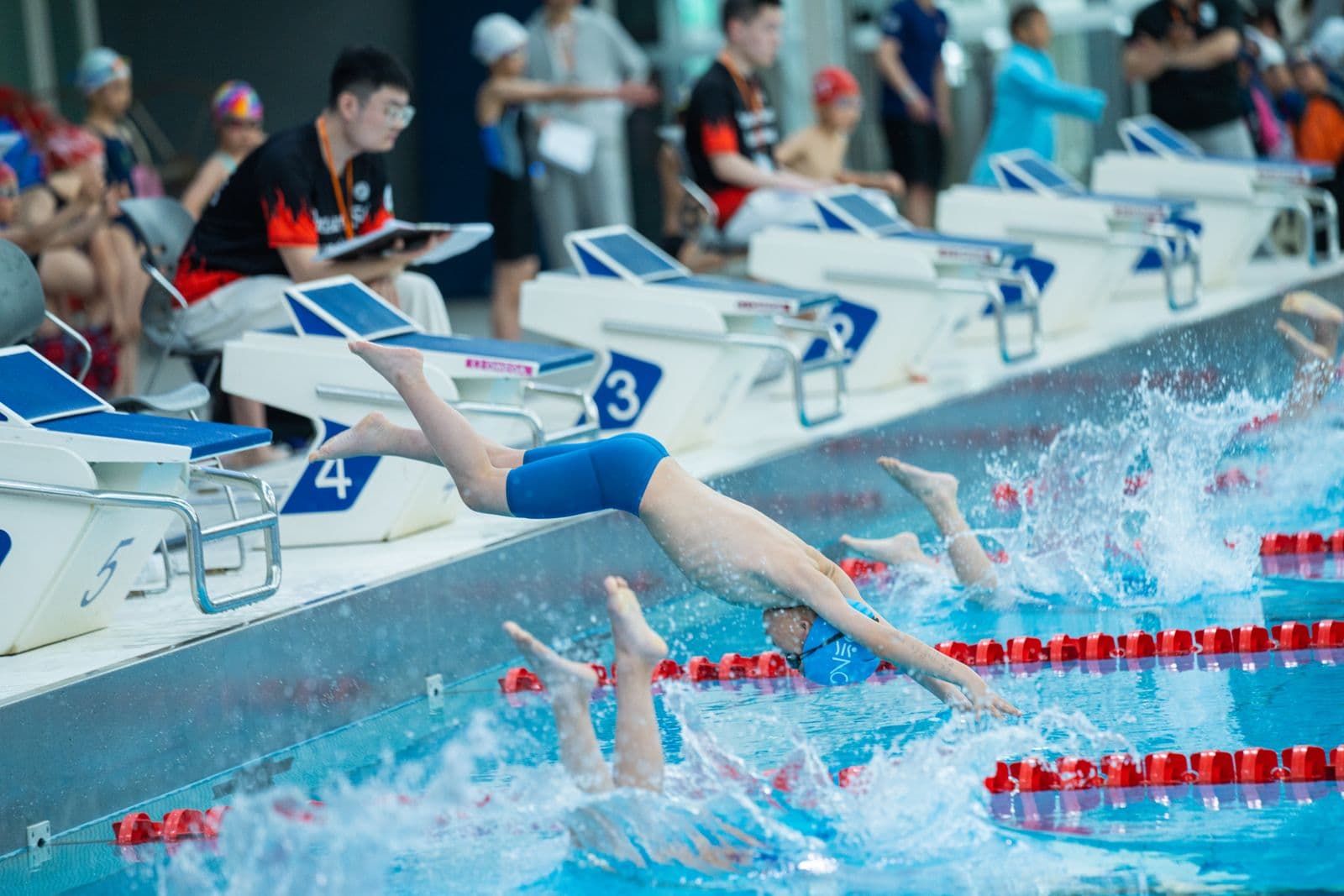
Sports medicine's warnings about early specialization — one sport, year-round, high hours, young age — describe club swimming almost exactly. Ten-plus practice hours a week by age twelve is routine at competitive clubs, and unlike field sports, nearly every one of those hours loads the same joint: a growing shoulder doing thousands of overhead strokes per practice.
None of this makes swimming a bad choice — it remains one of the healthiest sports a kid can do, and most club swimmers never have a serious problem. It does mean the volume is adult-sized while the tissues aren't, so the warning signs are worth knowing.
The complaints that matter
Shoulder pain is the headline. In a growing swimmer it's almost always overuse — the same swimmer's shoulder pattern adults get, arriving faster because growth spurts change mechanics mid-season and strength lags behind new height. Caught early, it's a few weeks of modified training; pushed through a championship season, it can shut down the taper and the meet. The traffic-light rules translate well to teenagers.
Knee pain in breaststrokers is the sport's second signature — breaststroke knee loads the inner knee with every whip kick, and growing knees are less forgiving of big breaststroke blocks. Pain at the kneecap's lower edge in a swimmer who's also sprouting two inches a year deserves the same early look.
Back pain shows up in butterfliers and heavy-dolphin-kick training — the low back guide covers when it's muscular fatigue and when it needs attention now.
Sore vs. hurt — and why kids won't tell you
The distinction worth teaching at the dinner table: sore is both shoulders, after hard practices, gone in a day or two. Hurt is one spot, most practices, sticking around the next morning, or changing the stroke. Sore is training; hurt is information.
Then name the quiet part: club swimmers hide pain. Relay spots, travel teams, and time cuts all reward silence, and kids know it. A useful home screen — ask them to hold a light streamline overhead and then do ten slow arm circles on each side. Wincing, asymmetry, or "it's fine" through gritted teeth is a same-month evaluation, not a see-how-champs-goes.
The season-saving timeline
Swim seasons run long, and timing decides outcomes. A shoulder niggle mentioned in the first month of the season is usually a two-to-four week fix with modified yardage — the season survives intact. The same niggle surfacing three weeks before championships costs the taper, and sometimes the meet. The math is consistent: early evaluation costs a week of pull sets; late evaluation costs the part of the season everyone was training for.
What PT for a minor looks like
A parent or guardian books the visit, attends the evaluation, and consents to care. Expect the PT to spend real time on training history — weekly yardage, stroke specialty, equipment, recent growth, sleep, and fueling — because with young swimmers those answers matter as much as the exam. Fueling gets asked about for a reason: training hard on too little food quietly erodes recovery and bone health in every young athlete, in any body (sports medicine calls it RED-S). That conversation is about eating enough for the training load — it is never about weight — and a PT who works with young endurance athletes will frame it exactly that way.
Treatment plans lean on modified practice, not shutdown: most swimmers stay in the water with adjusted sets while dryland-style strengthening rebuilds the shoulder. Expect a written plan the coach can actually use.
Talking to the coach
Good coaches want the information early — a PT note that says "two weeks of kick-and-drill emphasis, no paddles, then graded return to full freestyle volume" keeps the swimmer with the team and the coach in the loop. What fails is the silent middle path where the athlete manages pain alone to protect a relay spot. Naming that dynamic at home is half the prevention. (Parents juggling a runner too: the cross country guide is this article's sibling.)
If you're local, ask specifically about experience with adolescent athletes — here's how to vet a swimming PT, and the Bay Area swimming PT directory is the place to start looking.
Frequently asked questions
Sources (7)
- DiFiori JP, et al. Overuse injuries and burnout in youth sports: a position statement from the American Medical Society for Sports Medicine. Clin J Sport Med. 2014. — Clin J Sport Med
- Mountjoy M, et al. The IOC consensus statement: beyond the Female Athlete Triad — Relative Energy Deficiency in Sport (RED-S). Br J Sports Med. 2014. — BJSM
- Bergeron MF, et al. International Olympic Committee consensus statement on youth athletic development. Br J Sports Med. 2015. — BJSM
- Hibberd EE, et al. Comparison of upper extremity physical characteristics between adolescent competitive swimmers and nonoverhead athletes. J Athl Train. 2016. — J Athl Train
- Kerr ZY, et al. Epidemiology of National Collegiate Athletic Association men's and women's swimming and diving injuries. Br J Sports Med. 2015. — BJSM
- Bell DR, et al. Sport Specialization and Risk of Overuse Injuries: A Systematic Review With Meta-analysis. Pediatrics. 2018. — Pediatrics
- McKenzie A, et al. Shoulder pain and injury risk factors in competitive swimmers: A systematic review. Scand J Med Sci Sports. 2023. — Scand J Med Sci Sports
This article is for education only and isn't medical advice. Always talk to a licensed clinician about your specific situation.