
Junior Golf Injuries: A Parent's Guide
Growing spines, high-speed rotation, and daily range sessions — what to watch and when to act
Updated October 20263 minute read
Competitive junior golf is now a year-round, high-volume sport, and its signature complaint is low back pain in a growing spine. Most junior golf problems are very fixable caught early — but persistent one-sided back pain that's worse with the finish position deserves an assessment, not toughing out, because adolescent spines can develop stress injuries adult backs don't. The parent's best lever is the range-ball budget.
Junior golf grew up fast
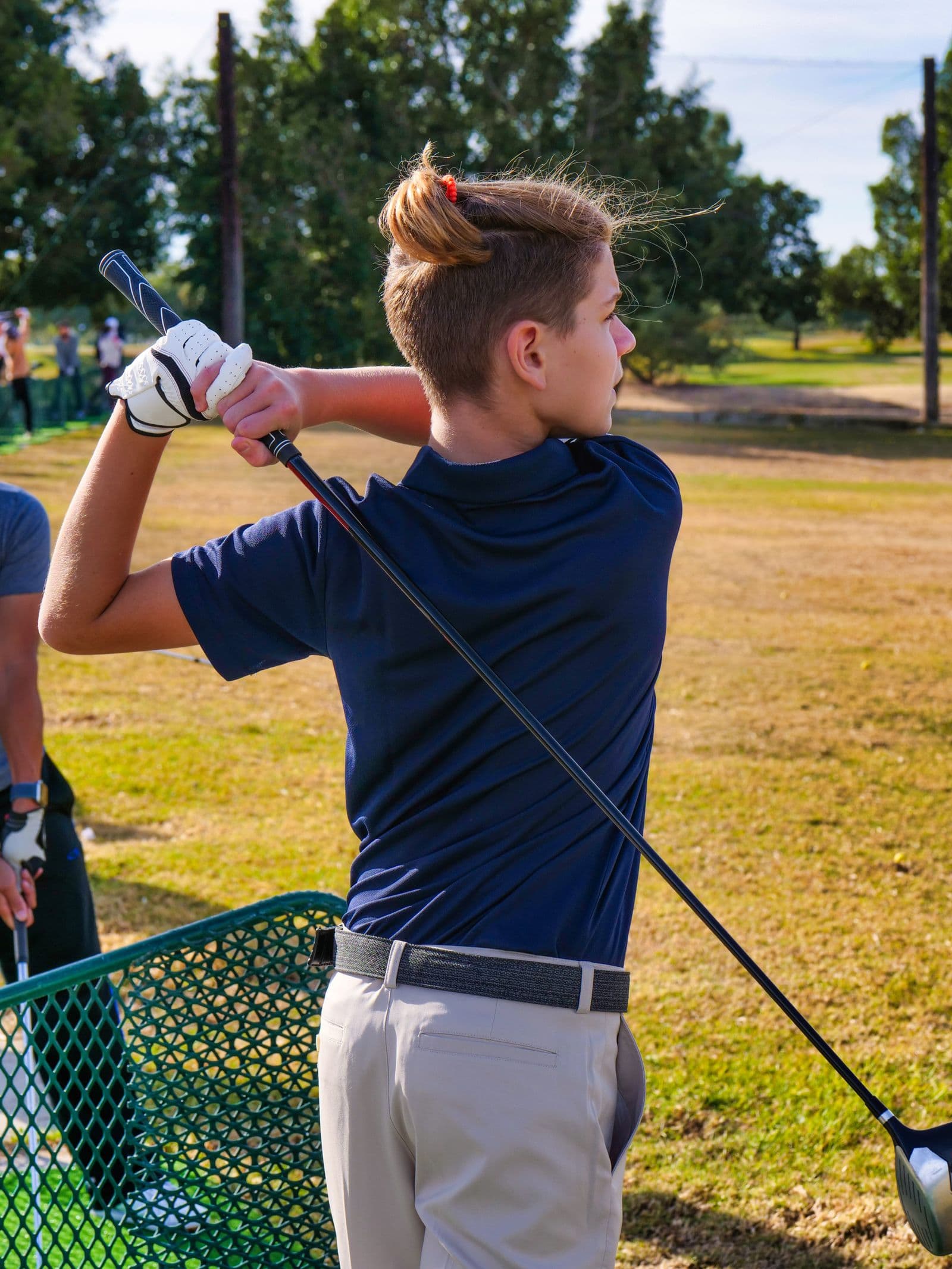
A generation ago junior golf meant summer. Now it means academies, national junior tours, swing coaches, launch monitors, and range sessions most days of the week — a year-round, single-sport schedule that sports medicine recognizes as the classic early-specialization pattern. Golf looks gentle from the cart path. To a growing spine producing high-speed rotation several hundred times a week, it's a real workload.
None of this makes junior golf unsafe. It makes the warning signs worth knowing — and the training volume worth parenting.
The junior-specific risk: a growing back
Low back pain is junior golf's signature complaint, and teenage backs differ from adult ones in a way that matters: the growing spine can develop bone stress injuries (the medical name is spondylolysis) at exactly the spot the golf swing loads hardest — the low back in extension and rotation, the finish position of every full swing.
The pattern that deserves attention, in plain language: one-sided low back pain that's worse with the follow-through or arching backward, that's lasted more than a couple of weeks, in a teenager who plays a lot of golf. That's an assessment-now situation — not a stretch-it-out, tough-it-out situation — because caught early it's weeks of modified training, and pushed through it can become a season-plus. (The adult version of golf back pain is a different conversation.)
The second pattern: wrist overuse from daily range volume, especially off mats — aching that builds across a practice week and quiets on rest days. Earlier is easier here too (the wrist guide covers the adult version of the territory).
Sore vs. hurt — the dinner-table version
Sore is general, both-sided, after hard practice, gone in a day or two. Hurt is one spot, most sessions, sticking around the next morning, or changing the swing. Sore is training; hurt is information.
And name the quiet part: competitive juniors hide pain. Rankings, academy spots, and college recruiting all reward silence, and kids know it. A useful home screen — ask them to hit the finish position and hold it. A wince there, or a swing that's visibly shortened to protect something, outranks anything they're telling you.
The parent's best lever: the range-ball budget
Coaches own technique; parents own volume. The highest-leverage thing a golf parent manages is total weekly load — balls hit, rounds played, speed sessions — and its rate of change. The load-management rules apply to juniors with one addition: during visible growth spurts, hold volume steady or trim it, because the same swing count costs more to a body that grew an inch since spring. A real warm-up is the other freebie.
What to expect from PT for a minor
A parent or guardian attends and consents. Expect questions about training history, recent growth, sleep, and school sport load alongside the movement exam — for juniors those answers matter as much as any test. Plans lean on modified training, not shutdown: most junior golfers keep practicing in some form (short game is usually open even when full swings are capped — the comeback ladder starts on the putting green). And a PT comfortable with adolescent athletes will coordinate with the swing coach — ask for that explicitly (how to vet a golf PT).
Bay Area families can browse golf-friendly PTs by region. Raising a multi-sport kid? The same playbook exists for cross country, club swimming, and tennis.
Frequently asked questions
Sources (6)
- DiFiori JP, et al. Overuse injuries and burnout in youth sports: a position statement from the American Medical Society for Sports Medicine. Clin J Sport Med. 2014. — Clin J Sport Med
- Leone A, et al. Lumbar spondylolysis: a review. Skeletal Radiol. 2011. — Skeletal Radiol
- AAOS OrthoInfo. Spondylolysis and Spondylolisthesis. — AAOS OrthoInfo
- Fradkin AJ, et al. Children's misadventures with golfing equipment. Int J Inj Contr Saf Promot. 2005. — Int J Inj Contr Saf Promot
- McHardy A, et al. Golf injuries: a review of the literature. Sports Med. 2006. — Sports Med
- Bell DR, et al. Sport Specialization and Risk of Overuse Injuries: A Systematic Review With Meta-analysis. Pediatrics. 2018. — Pediatrics
This article is for education only and isn't medical advice. Always talk to a licensed clinician about your specific situation.