
Wrist Pain in Tennis Players: Reading the Side That Hurts
Pinky side, thumb side, or back of the wrist — modern topspin tennis has a signature, and it's ulnar
Updated October 20262 minute read
Modern grips and heavy topspin have made the pinky side the tennis wrist's weak point: pain there with forehands and two-handed backhands points to the ECU tendon and TFCC region. Thumb-side pain tracks with gripping and lifting, and a diffuse ache across the back of the wrist usually follows volume spikes. Clicking, true weakness, or any fall onto the wrist skip self-management and go straight to evaluation.
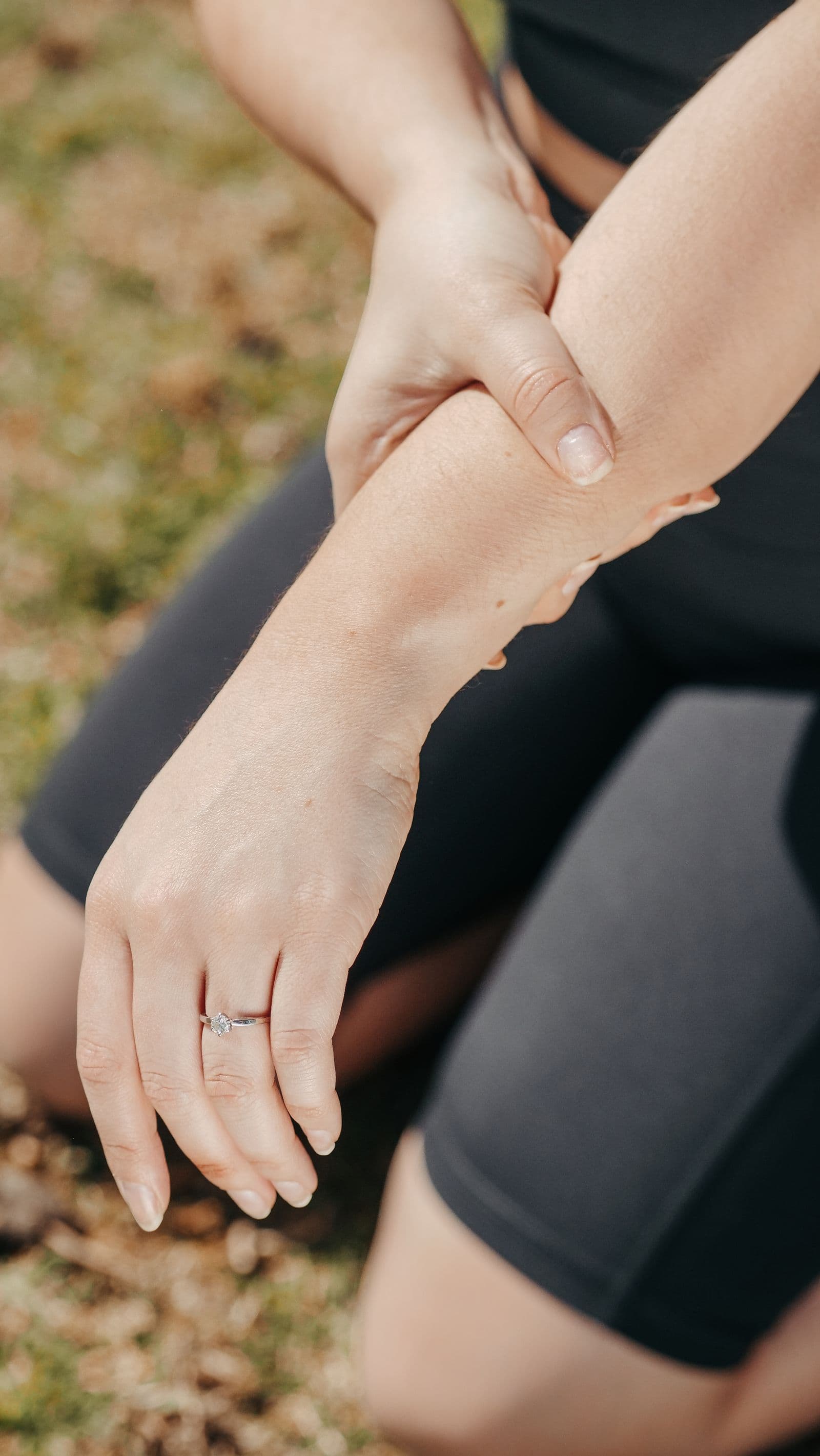
Why modern tennis hurts wrists
Flat, continental-grip tennis barely asked anything of the wrist. Modern tennis — semi-western and western grips, heavy topspin, two-handed backhands — turned the wrist into an active power link, snapping through contact on every forehand. Reviews of tennis wrist injuries point at exactly that shift: the more extreme the grip and the heavier the spin, the more load lands on the pinky side of the wrist.
Match your pattern:
Pinky side: the modern signature
Pain on the little-finger side, flaring with topspin forehands, the non-dominant wrist of two-handed backhands, and rotating motions off court (turning a key, pouring a kettle). Sometimes a click or a feeling of instability. This is ECU-tendon and TFCC territory — the tendon that runs along that edge and the cartilage complex beneath it. Wrist pain on the pinky side covers the full pattern. Treat this one with respect: persistent clicking, giving-way, or pain that survives three weeks of sensible load management deserves a proper diagnosis, because the tendon version and the cartilage version are managed differently.
Thumb side: gripping and lifting
Pain at the thumb side of the wrist that flares with gripping the racquet, lifting a bag, or wringing motions — and often as much off court as on. This side's problems live in the thumb tendons and respond well to a spell of load modification plus progressive strengthening.
Back of the wrist: the volume ache
A diffuse ache across the back of the wrist after a heavy week — new league season, a weekend tournament, a stretch of daily hitting — without one pressable spot or any clicking. This is the most benign pattern: classic overload that settles with a load trim and builds back with basic wrist strengthening.
The equipment conversation
The wrist is where equipment choices quietly collect their tax: an oversized or undersized grip changes how hard you squeeze; a heavier racquet or very high string tension raises every impact's bill; extreme grips put the wrist in its loaded position before the ball even arrives. None of these are automatically wrong — but when wrist pain recurs, the racquet and equipment guide is a cheap first audit, and a tennis-literate PT will ask about your setup in the first ten minutes.
Self-manage or book?
Two-week self-management trial is reasonable for: the volume ache, mild thumb-side pain, or mild pinky-side pain with no clicking. Trim volume a third, audit the grip, add gentle wrist strengthening in all four directions, and watch the trend.
Book now for: any fall onto the wrist (wrist sprain needs sorting from something worse), persistent clicking or instability, true weakness, pins and needles, or pain that's unchanged after two honest weeks. Do I need PT for wrist or hand pain? covers the thresholds. A cash-pay evaluation runs $125–$250 (what PT costs, often partly recoverable via superbill), and Bay Area players can browse tennis-savvy PTs by region — here's what to ask anyone you find.
Frequently asked questions
Sources (6)
- Stuelcken M, et al. Wrist Injuries in Tennis Players: A Narrative Review. Sports Med. 2017. — Sports Med
- AAOS OrthoInfo. de Quervain's Tendinosis. — AAOS OrthoInfo
- Pluim BM, et al. Tennis injuries: occurrence, aetiology, and prevention. Br J Sports Med. 2006. — BJSM
- Abrams GD, et al. Epidemiology of musculoskeletal injury in the tennis player. Br J Sports Med. 2012. — BJSM
- Rossi J, et al. Potential effects of racket grip size on lateral epicondilalgy risks. Scand J Med Sci Sports. 2014. — Scand J Med Sci Sports
- Cuenca-Zaldívar JN, et al. Conservative treatments for De Quervain's tenosynovitis: A systematic review and network meta-analysis. J Hand Ther. 2026. — J Hand Ther
This article is for education only and isn't medical advice. Always talk to a licensed clinician about your specific situation.