
Racquets, Strings & Tennis Elbow: What Your Gear Actually Does to Your Arm
Grip size, string tension, frame stiffness — the setup choices that load your elbow, and the ones that just change the sound
Updated October 20262 minute read
Equipment genuinely matters for a tennis player's arm — a too-small grip, a stiff dead polyester string bed, and a light stiff racquet each raise the shock and grip force the forearm absorbs. But no setup is armor: gear redistributes load, training volume creates it, and every equipment change is itself a load change your arm needs time to absorb.
Equipment is real — and it isn't armor
Two things are true at once. A bad setup genuinely raises the load your forearm absorbs on every stroke — equipment is one of the few injury factors you can change with a credit card. And no setup prevents tennis elbow by itself, because gear redistributes load while training spikes create it. Fix the setup and respect the load math; neither substitutes for the other.
Grip size: the cheapest fix in tennis
A grip that's too small makes you squeeze harder on every stroke to stop the racquet twisting — and constant extra grip force is exactly the demand the outer-elbow tendons hate. The classic starting measure: the distance from the middle crease of your palm to the tip of your ring finger. From there, comfort rules — and when between sizes, go smaller and build up with an overgrip. If your racquet twists on off-center hits or your forearm pumps up faster than your legs, size is the first suspect. Cost of the experiment: a few dollars of overgrip.
Strings: where most elbow stories start
- Tension: lower tension gives more power and less shock; high tension gives control and more vibration into the arm. If your elbow is talking, dropping a few pounds is a free, reversible experiment.
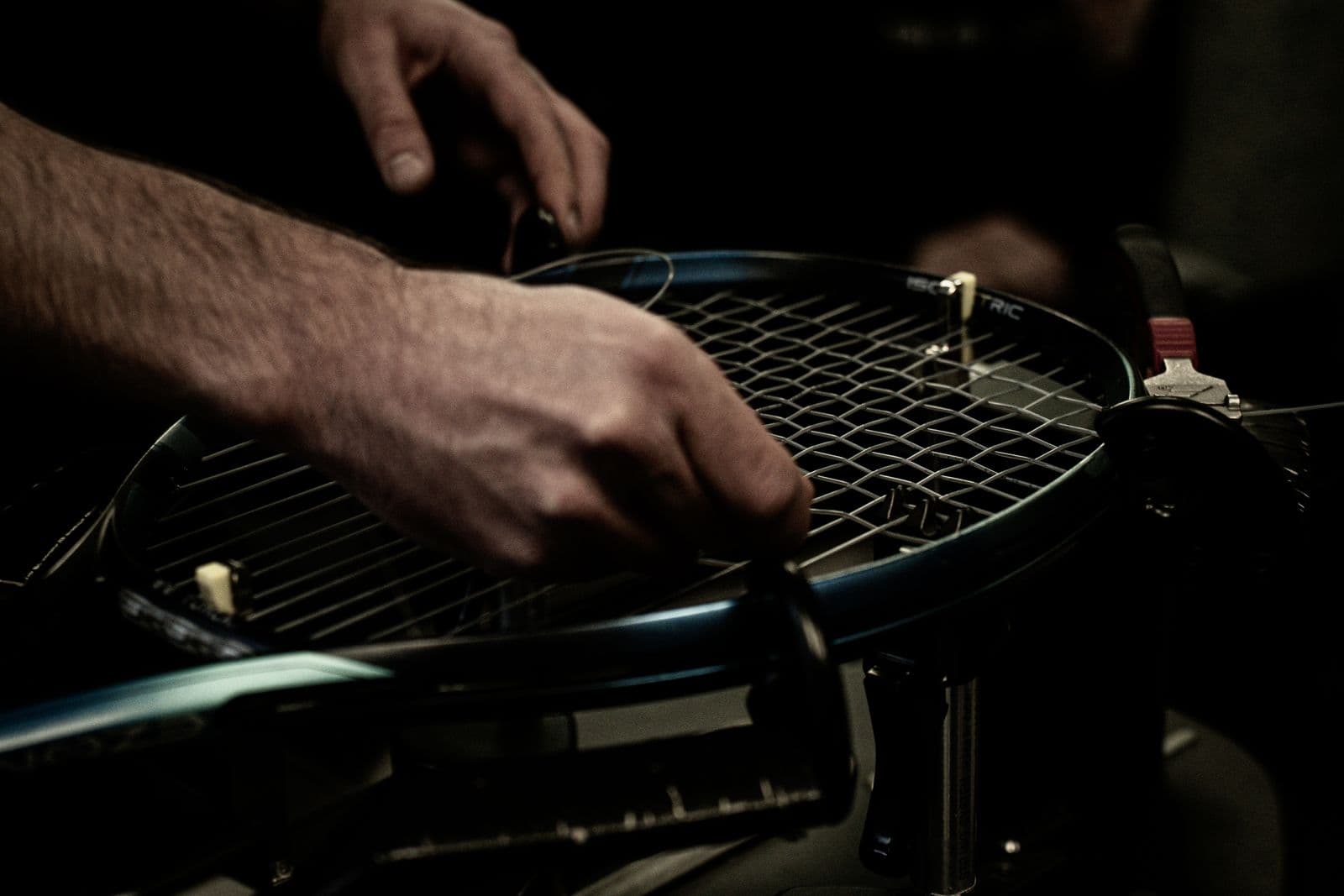
- Type: stiff polyester strings earn their popularity with spin and durability — and they're the harshest thing you can put in a racquet, especially once dead. Softer multifilaments and natural gut are dramatically more arm-friendly. A hybrid (poly mains, soft crosses) splits the difference.
- The classic elbow recipe: full polyester, strung tight, played months past dead. If that's your current setup and your elbow aches, you've found this article's most actionable sentence.
The frame: weight, balance, stiffness
Shock that the racquet doesn't absorb, your arm does. Very light frames transmit more; very stiff frames transmit more; head-heavy balance adds leverage against your forearm. The arm-friendly direction is mid-weight, moderate flexibility, slightly head-light — and the trade-off is honest: heavier racquets ask more fitness of your shoulder and forearm, which is a training problem with a training solution.
The meta-rule: every change is a load change
A new racquet, a string switch, even a grip-size change alters where and how load lands in your arm — which makes the change itself a spike. Introduce one change at a time, with a lighter hitting week around it, exactly as you'd manage any other load jump. The player who buys a new racquet, restrings at higher tension, and starts a league in the same month has changed four variables and will never know which one lit the fuse.
Racquet tech or PT? Both — different jobs
Your stringer optimizes the racquet; a PT optimizes the arm holding it. If your elbow flares track with equipment changes, bring the history to both: the setup tweaks calm the load, and the forearm loading program rebuilds the capacity that makes you resilient to any racquet. Pain that's lasted more than two weeks — or hurts with daily gripping — earns the evaluation: $125–$250 cash-pay (what PT costs, often partly recoverable via superbill). Bay Area players can find racquet-literate PTs in the tennis PT directory.
Frequently asked questions
Sources (6)
- Hennig EM. Influence of racket properties on injuries and performance in tennis. Exerc Sport Sci Rev. 2007. — Exerc Sport Sci Rev
- Rossi J, et al. Potential effects of racket grip size on lateral epicondilalgy risks. Scand J Med Sci Sports. 2014. — Scand J Med Sci Sports
- Coombes BK, et al. Management of Lateral Elbow Tendinopathy: One Size Does Not Fit All. J Orthop Sports Phys Ther. 2015. — JOSPT
- AAOS OrthoInfo. Tennis Elbow (Lateral Epicondylitis). — AAOS OrthoInfo
- Pluim BM, et al. Tennis injuries: occurrence, aetiology, and prevention. Br J Sports Med. 2006. — BJSM
- Karanasios S, et al. Exercise interventions in lateral elbow tendinopathy have better outcomes than passive interventions, but the effects are small: a systematic review and meta-analysis of 2123 subjects in 30 trials. Br J Sports Med. 2021. — Br J Sports Med
This article is for education only and isn't medical advice. Always talk to a licensed clinician about your specific situation.