
Court Surfaces and Tennis Shoes: What Your Ankles Want You to Know
Hard court vs. clay through a PT lens — and why running shoes don't belong on either
Updated October 20262 minute read
Each court surface loads the body differently: hard courts are the fastest and most demanding on ankles and knees, clay is joint-friendlier but demands sliding control, and any surface switch is a training-load change worth respecting. The footwear rule is simpler: tennis shoes are built for lateral cuts and running shoes are not — playing tennis in running shoes is a rolled ankle waiting for a scheduling conflict.
The surface is a training variable
Players think of surfaces as speeds. Your tissues experience them as load profiles — each one asks different structures to do the work, and switching between them is a change your body has to absorb, the same way a jump in playing hours is.
Hard courts — the Bay Area default, from Golden Gate Park's public courts to every club and school — are the honest extreme: fast ball, firm footing, and full-force stops. Every sprint ends in a deceleration your ankles, knees, and calves absorb; every direction change is a hard plant. It's the surface most implicated in ankle sprains and cranky knees — and it's also completely manageable for players whose legs are trained for it, which is the real argument for strength work.
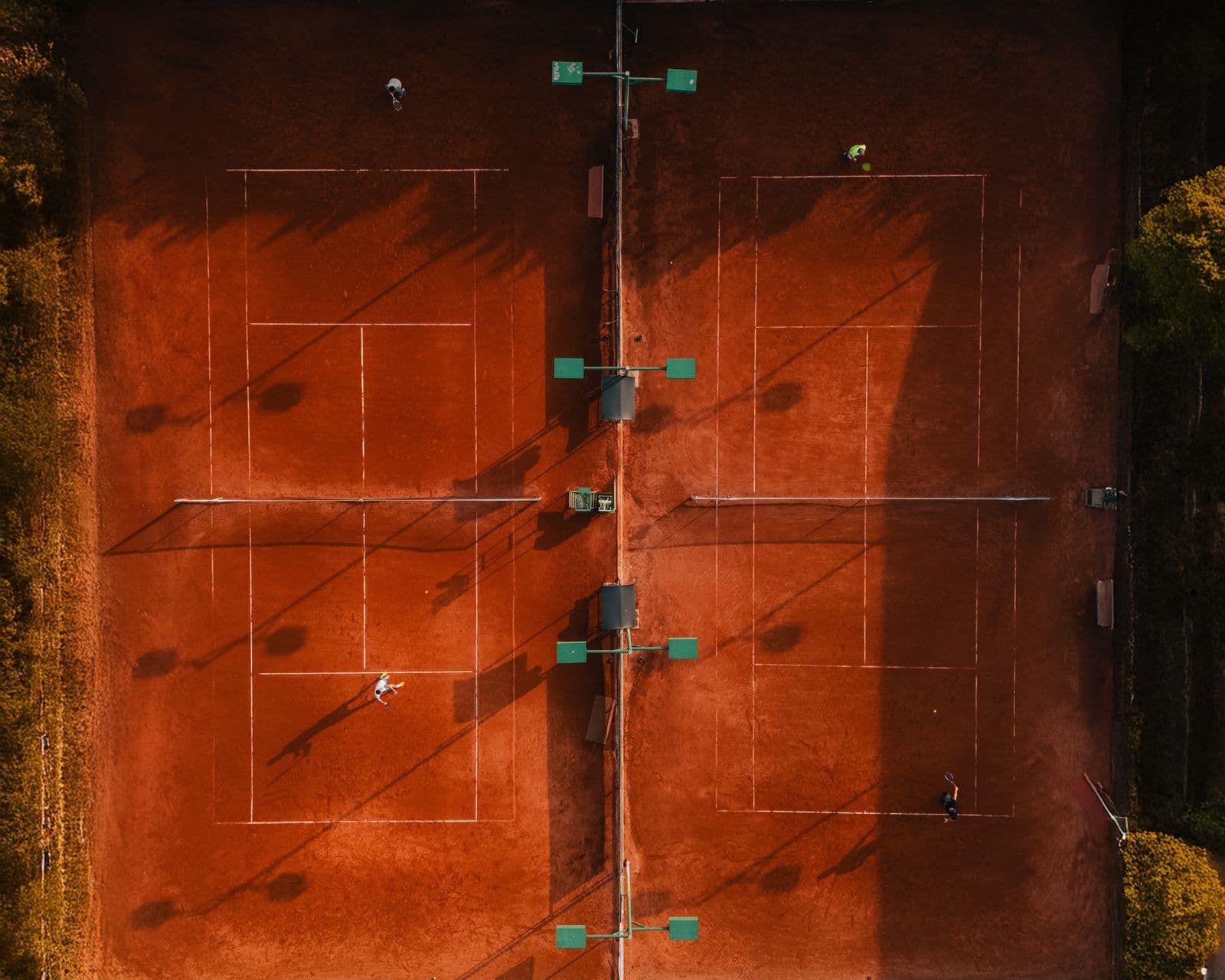
Clay is the forgiving one — the surface gives, so stops become slides and peak loads drop. The trade: sliding is a skill with its own demands (hip and groin control, longer points, more total running), and players new to clay often feel muscles they didn't know tennis used. Clay courts are rare but findable around the Bay; treat your first weeks on them as new training, not easy training.
Grass — mostly a curiosity here — plays low and quick, rewards short steps, and asks sudden hamstring questions. If you get a grass invite, warm up accordingly.
The switch rule: whatever the surfaces involved, a surface change is a load change. Returning from vacation clay to league hard courts, or adding a second weekly hard-court night, deserves the same gradual on-ramp as any other training spike.
Shoes: one rule, then details
Play tennis in tennis shoes. Running shoes are built for one direction; their soft, high stacks and minimal lateral structure are exactly wrong for a sport made of side-to-side cuts — the classic rolled ankle on a routine wide ball. This isn't gear marketing; it's geometry.
Once that's settled, the traits that matter:
- Lateral stability — a firm midsole and outriggered sole that resist rolling. The feature that justifies the category.
- Outsole matched to surface — durable "all court" rubber for Bay Area hard courts (soft outsoles shred in weeks); full herringbone tread if you play clay, for controlled sliding.
- Fit for your foot, comfort as the filter — same honest rule as running shoes: within the right category, the shoe that feels best wins. Wide-foot players have real options; a half-size of toe room saves toenails on hard stops.
- Fresh enough to grip — a slick pivot zone changes how you move whether you notice or not.
When footwear belongs in a PT conversation
Most tennis injuries are load stories, not shoe stories — but footwear earns clinical attention when ankle sprains keep recurring (the shoe is one variable; the bigger fix is the ankle strength and balance work a PT will build after an ankle sprain), when foot or Achilles pain tracks with a shoe's age, or when you're returning from injury and want every variable on your side. A cash-pay evaluation runs $125–$250 ($175–$275 locally; what PT costs) — and Bay Area players can find racquet-literate PTs in the tennis PT directory.
Frequently asked questions
Sources (5)
- Girard O, et al. Effects of the playing surface on plantar pressures during the first serve in tennis. Int J Sports Physiol Perform. 2010. — IJSPP
- Doherty C, et al. The incidence and prevalence of ankle sprain injury: a systematic review and meta-analysis of prospective epidemiological studies. Sports Med. 2014. — Sports Med
- Dizon JM, Reyes JJ. A systematic review on the effectiveness of external ankle supports in the prevention of inversion ankle sprains among elite and recreational players. J Sci Med Sport. 2010. — J Sci Med Sport
- AAOS OrthoInfo. Sprained Ankle. — AAOS OrthoInfo
- Pluim BM, et al. Tennis injuries: occurrence, aetiology, and prevention. Br J Sports Med. 2006. — BJSM
This article is for education only and isn't medical advice. Always talk to a licensed clinician about your specific situation.