
Badminton Court Shoes and Footwork: The Gear That's Actually Medical
Why running shoes are a liability on court, what real badminton shoes do, and how footwork doubles as load management
Updated October 20263 minute read
Badminton is played sideways and the shoes have to be too: real court shoes trade cushioned straight-line comfort for a low, stable, non-marking gum-rubber platform built for lunges and lateral cuts. Running shoes — tall, soft, and built for one direction — are the most common equipment mistake in recreational play. The other half of the equation is footwork: lunge mechanics and split-step habits decide how much force your calf, knee, and ankle absorb on every rally.
The sideways sport in straight-line shoes
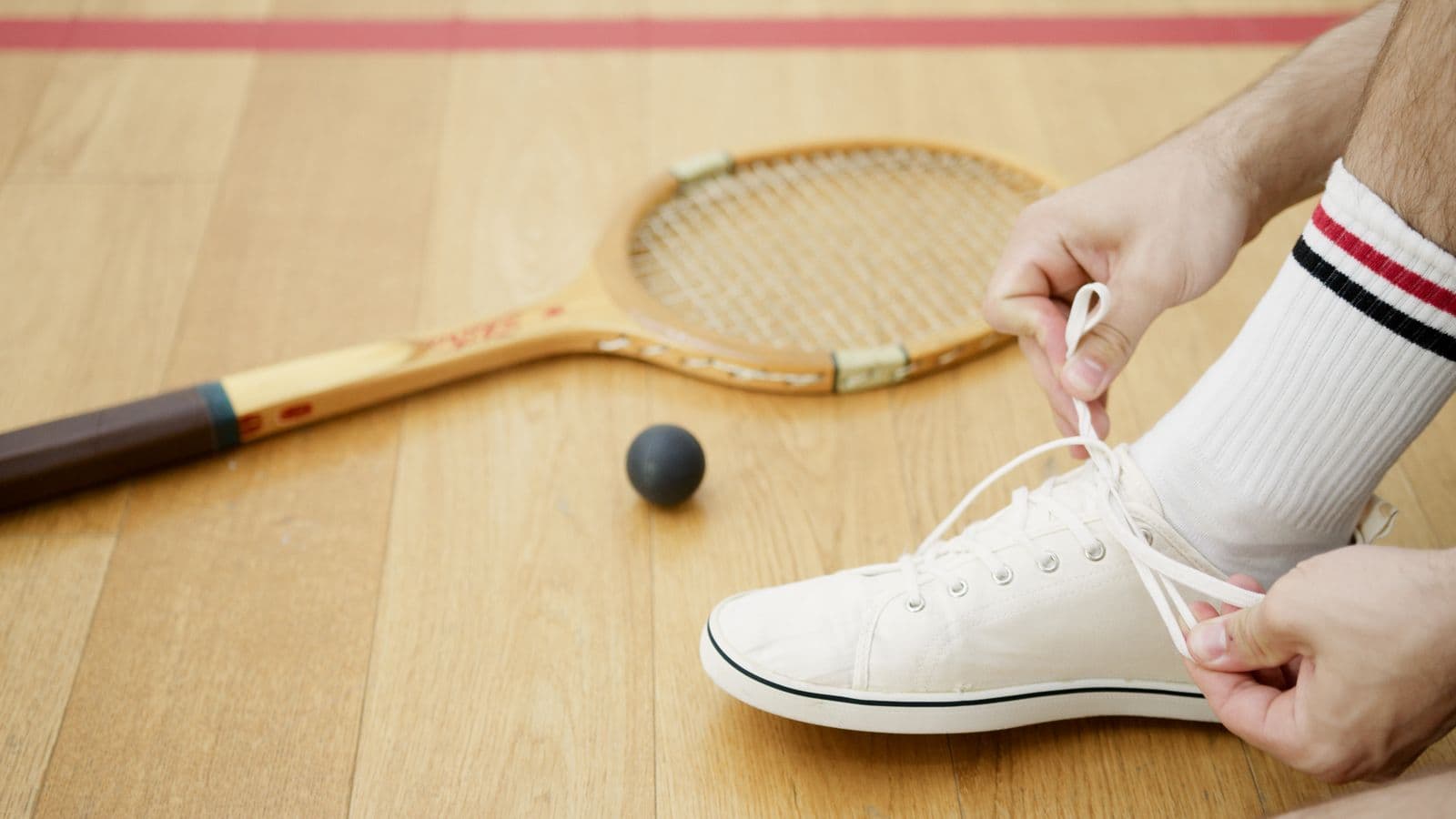
Walk into any club night and you can spot the newer players by their feet: running shoes, built beautifully for moving in one direction, on a court that demands a hundred lateral cuts and lunges an hour. Badminton's injury epidemiology has always been a lower-limb story — ankles, calves, Achilles — and footwear is one of the few risk factors you can fix with a single purchase.
This page isn't gear shopping; it's the medical case for the right tool, and for the footwork habits that are gear's equal partner.
What a court shoe actually does
- Non-marking gum-rubber sole — engineered grip for wood and synthetic courts: enough to cut hard, calibrated so your foot can still pivot instead of sticking and twisting.
- Low, firm platform — your foot sits close to the floor, so lateral forces roll through the shoe instead of tipping over a tall cushioned heel. Research on lunge loading even shows heel design changes the forces and knee moments players absorb.
- Lateral structure — the upper holds your foot over the sole on cuts, which is the job running uppers never had.
- Forefoot room — lunges jam toes forward; a thumb's width of space is the difference between footwork and bruised nails.
Badminton-specific shoes are ideal; volleyball and squash shoes fit the same brief. What doesn't: running shoes, basketball highs (built for a different weight class of jumps), and anything with a worn-smooth sole. The orthopedic guidance on athletic shoes says it plainly — match the shoe to the sport's actual movements.
The worn-out shoe problem
Gum rubber is a consumable. When the forefoot tread polishes smooth, grip becomes a guess — and players respond with tense, late, compensating footwork, which is precisely the style that rolls ankles and strains calves. Frequent players should expect to replace court shoes every 6–12 months. "The floor felt slippery tonight" is, more often than not, a shoe confession.
Footwork as load management
Every rally bills your legs; technique sets the price.
- The split-step. A small hop as your opponent strikes gets you moving early — early movement means balanced lunges, and balanced lunges load tendons on their terms.
- Lunge mechanics. The biomechanics literature treats the badminton lunge as a skill: heel-first contact, knee tracking over the foot, chest tall, push back through the whole leg. Desperate toe-first stabs with a collapsing knee are where the force goes feral.
- Recovery steps. Good players lunge and return; tired or untrained players lunge and lean. The return step is calf work — capacity training is what keeps it crisp in game five.
- Don't let shoes excuse footwork, or footwork excuse load. New shoes won't fix a spiked schedule, and perfect lunges won't save a smooth-soled shoe.
When the gear check isn't enough
If pain is already shaping your movement — a calf that guards, an ankle that doesn't trust cuts, a knee that complains on every lunge — the fix is an assessment, not another insole. A PT who works with court athletes will watch you lunge, test what's weak, and build the way back: how to find one, with Bay Area players able to browse local badminton-friendly PTs. Evaluations run $125–$250 cash-pay ($175–$275 in the Bay Area) — what PT costs — and a superbill usually recovers part of it if your plan has out-of-network benefits.
Frequently asked questions
Sources (6)
- Kuntze G, et al. A biomechanical analysis of common lunge tasks in badminton. J Sports Sci. 2010. — J Sports Sci
- Lam WK, et al. Does shoe heel design influence ground reaction forces and knee moments during maximum lunges in elite and intermediate badminton players? PLoS One. 2017. — PLoS One
- Jørgensen U, Winge S. Epidemiology of badminton injuries. Int J Sports Med. 1987. — Int J Sports Med
- AAOS OrthoInfo. Athletic shoes. — OrthoInfo
- ChoosePT (APTA). Physical therapy guide: ankle sprain. — ChoosePT
- Doherty C, et al. Treatment and prevention of acute and recurrent ankle sprain: an overview of systematic reviews with meta-analysis. Br J Sports Med. 2017. — BJSM
This article is for education only and isn't medical advice. Always talk to a licensed clinician about your specific situation.