
Postpartum Return to Running: A Realistic Timeline
Why the six-week clearance isn't a running green light — and what readiness actually looks like
Updated October 20263 minute read
The six-week postpartum checkup clears you for general activity — it doesn't assess whether your body is ready for impact. Current guidelines point to a graded path: walking and rebuilding strength first, running typically somewhere around 3–6 months postpartum, timed by readiness signs rather than the calendar. Leaking, pelvic heaviness, or pain are signals to adjust the plan, not push through.
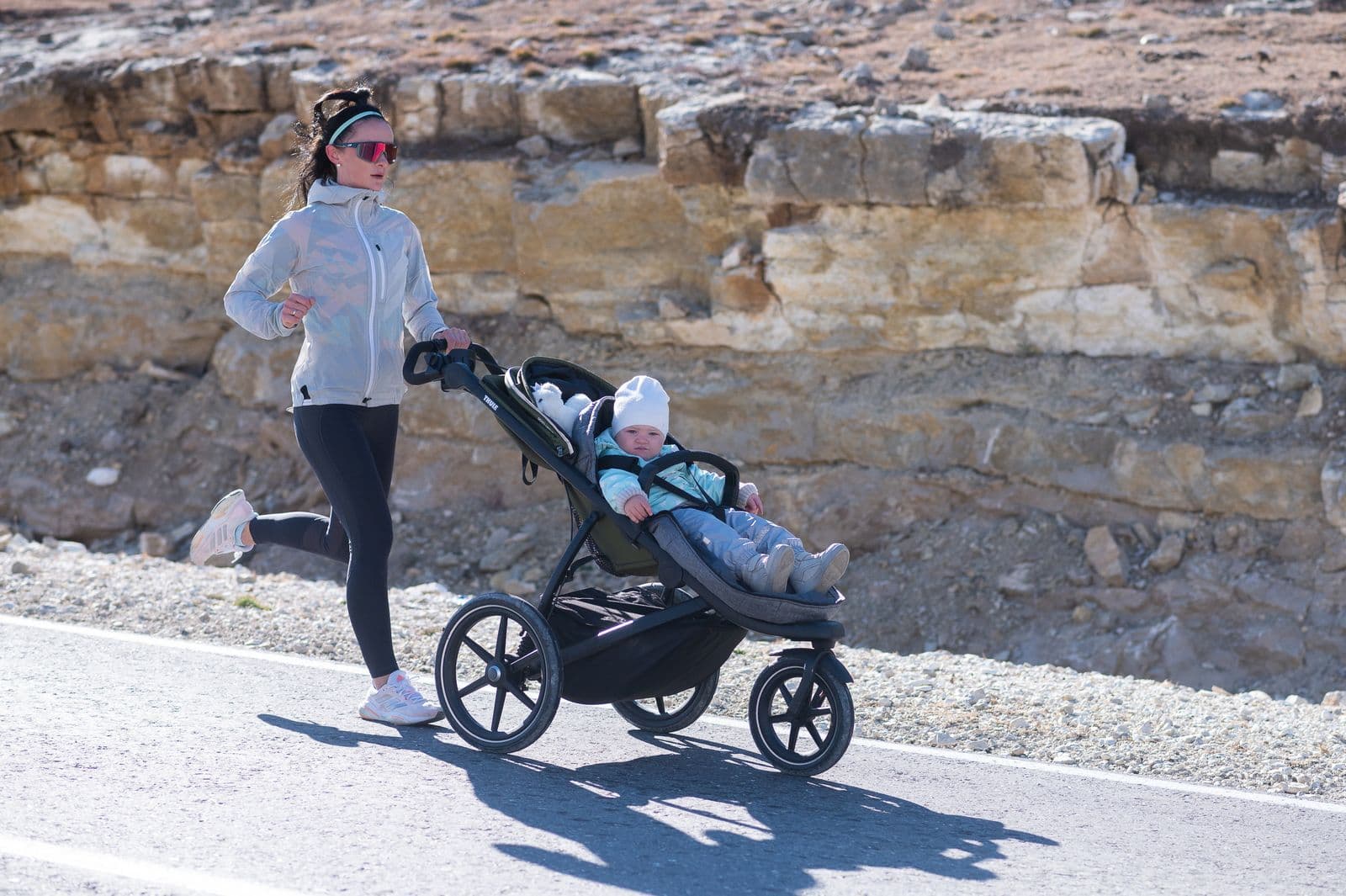
Why six weeks isn't the finish line
The six-week checkup answers a medical question: is your recovery from pregnancy and delivery on track? It does not answer the running question: can your pelvic floor, abdominal wall, hips, and feet absorb two to three times your body weight, roughly 170 times per minute, for half an hour?
Those are different questions. Running is one of the highest-impact things most people ever ask of a postpartum body, and the structures that matter most — the pelvic floor and deep abdominal wall — are exactly the ones pregnancy and delivery worked hardest. The widely used postnatal running guideline (Goom, Donnelly & Brockwell) lands on a pragmatic answer: build with walking and strength first, and return to actual running around 3–6 months postpartum for many people, based on readiness rather than a date. Some get there earlier, some later — the timeline serves the body, not the other way around.
What readiness looks like
Before run-walk intervals make sense, you want to be able to do things like walk 30 minutes comfortably, single-leg balance and squat without pain or heaviness, and hop in place without leaking, pressure, or pain. Those simple tests are the heart of a return-to-running assessment — they measure what the calendar can't.
The signals to respect mid-progression: leaking with impact, heaviness or dragging pressure in the pelvis, pain, or symptoms that show up the evening after a session. None of these mean running is over. They mean the demand got ahead of the rebuild — scale back a level and shore up the gap, ideally with professional eyes on it.
What a pelvic health PT actually does
A pelvic health assessment covers the things no training plan can see from outside: how the pelvic floor contracts, relaxes, and coordinates under load, how the abdominal wall is recovering (including any separation), and how you strategize breath and pressure when you lift or land. From there, rehab looks surprisingly like athletic training — progressive strength for the pelvic floor, hips, and calves — because that's what it is.
The strongest setup pairs that with a running-side plan: a graded run-walk progression, sensible terrain choices, and often a gait check once you're running continuously. Some PTs cover both sides; otherwise a pelvic health PT and a running-focused PT make a natural tag team. In the Bay Area, start with the running PT directory and ask each clinic about pelvic health experience — cash-pay means you can pick the combination that fits rather than whoever a network assigns. An evaluation runs $125–$250 in most cities (what PT costs), and HSA/FSA funds apply.
The progression itself
Once readiness checks pass, the structure mirrors any return after a long break: run-walk intervals three days a week, growing the run segments over several weeks, then continuous running before any speed or distance goals. Two postpartum-specific additions: keep the strength work going throughout (pelvic floor and hips are the engine of this comeback), and judge each step up by how you feel that evening and the next day, not just mid-run.
Be patient with the comparison game. Pregnancy is roughly a year of deconditioning plus a major physical event; rebuilding over months isn't slow, it's proportional. Runners who rebuild this way don't just get back — they usually come back with stronger hips and better pressure mechanics than they had before.
Frequently asked questions
Sources (5)
- Goom T, Donnelly G, Brockwell E. Returning to running postnatal — guidelines for medical, health and fitness professionals. 2019. — Goom, Donnelly & Brockwell
- ACOG Committee Opinion No. 804: Physical Activity and Exercise During Pregnancy and the Postpartum Period. 2020. — ACOG
- Nielsen RO, et al. Training errors and running related injuries: a systematic review. Int J Sports Phys Ther. 2012. — IJSPT
- Silbernagel KG, et al. Continued sports activity, using a pain-monitoring model, during rehabilitation in patients with Achilles tendinopathy. Am J Sports Med. 2007. — AJSM
- APTA ChoosePT. Patient guides to conditions, treatments, and finding a physical therapist. — ChoosePT
This article is for education only and isn't medical advice. Always talk to a licensed clinician about your specific situation.